Category: Capital Market

  • What is a Commodity Exchange?

    What is a Commodity Exchange?

    A commodity exchange is an organized marketplace where commodities are traded. Commodities exchanges usually deal in standardized contracts that have been assigned a particular grade by an official grading system. These exchange-traded contracts can be bought and sold on the exchange floor or electronically.

    In basic terms, a commodity exchange is a marketplace where buyers and sellers can trade commodities. Commodities are standardized products that are typically used as inputs in the production of other goods or services. The most common examples of commodities include metals (such as gold and silver), energy (such as oil and gas), agricultural products (such as corn, wheat, and soybeans), and precious stones (such as diamonds).

    The primary purpose of a commodity exchange is to provide a platform for trading activities and to ensure the orderly pricing and settlement of transactions. Most exchanges also offer other services, such as storage facilities for traded commodities, financial derivatives products, and various types of market information. Commodity exchanges have existed for centuries.

    One of the oldest is the London Metal Exchange, which was founded in 1877. Today, there are dozens of commodity exchanges around the world with varying degrees of regulation. Some exchanges are open only to members while others allow anyone to trade.

    Commodities Market For Beginners | Edelweiss Wealth Management explains well:

    What is a Commodity Exchange?

    A commodity exchange is a marketplace where traders can buy and sell commodities. These exchanges exist for a variety of different commodities, including metals, energy, agricultural products, and livestock. Commodity exchanges typically use standardised contracts to trade commodities.

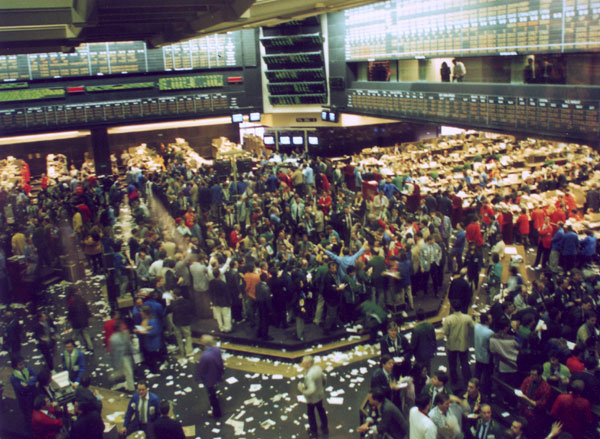
    This allows for easy trading and price discovery. The prices on a commodity exchange are determined by supply and demand forces in the market. Trading on a commodity exchange can be done either electronically or through pit trading.

    Pit trading is the traditional method of trading where traders shout out their orders to each other in an open-outcry system. Electronic trading has become more popular in recent years as it offers a number of advantages over pit trading. These include lower transaction costs, greater transparency, and faster execution speeds.

    The most well-known commodity exchanges in the world are the Chicago Mercantile Exchange (CME) and the New York Mercantile Exchange (NYMEX). These exchanges trade a variety of different commodities including metals, energy, livestock, and agricultural products.


    The first commodity exchange was founded in 1710 in Amsterdam. Today, there are many different commodity exchanges around the world. However, the United States got its earliest official commodity trading exchange, The Chicago Board of Trade (CBOT), in the West in 1848. 

    How Does a Commodities Exchange Work?

    A commodities exchange is a market where raw or primary products are traded. These products are often standardized in terms of quality and quantity and are traded on an organized exchange. Commodities exchanges usually trade futures contracts, which are agreements to buy or sell a particular commodity at a set price on a specified date in the future.

    The first step in trading on a commodities exchange is to find a broker that belongs to the exchange. You will then need to open an account with the broker and deposit money into it. Once you have done this, you can start placing orders for futures contracts through your broker.

    When you place an order, you will need to specify the type of contract you want, the amount of the commodity you want to buy or sell, and the price at which you are willing to trade. Your order will then be matched with another order from another trader and the trade will be executed. Once a trade has been executed, both parties are obliged to fulfill their side of the contract.

    If you have bought a futures contract, this means that you agree to take delivery of the commodity on the specified date and at the agreed-upon price. If you have sold a futures contract, this means that you agree to deliver the commodity on the specified date and at the agreed-upon price.

    Stock Exchange Vs Commodity Exchange?

    A stock exchange is a market where stocks (pieces of ownership in businesses) are traded between investors. A commodity exchange is a market where raw materials or other commodities are traded between buyers and sellers. The most famous commodity exchange in the world is the Chicago Mercantile Exchange, which trades in a variety of commodities, including agricultural products, energy, metals, and currencies.

    What is an Example of a Commodity Market?

    A commodity market is a marketplace where raw or primary products are exchanged. These products are traded on an authorized commodities exchange and can be either physical or financial in nature. The most common examples of physical commodities include agricultural products (such as wheat, corn, soybeans, etc.), livestock (including pork bellies, live cattle, etc.), metals (like gold, silver, copper), energy (oil, natural gas), and precious stones (such as diamonds).

    Financial commodities include foreign currencies, Treasury bonds and stock indexes. Commodity markets date back centuries and have been known to play an important role in the development of civilizations. In fact, many historians believe that the origins of money can be traced back to ancient commodity markets.

    Today, commodity markets continue to play a vital role in our global economy. They provide producers with a way to hedge against price fluctuations and allow investors to speculate on future movements in prices.

    Types of Commodity Exchange

    A commodity exchange is an organized marketplace where traders can buy and sell standard contracts for underlying physical commodities. These contracts can be for immediate delivery, or for future delivery. Commodity exchanges began in the 19th century to provide a place for farmers and other producers to sell their crops and livestock.

    Today, there are exchanges all over the world that trade in a wide variety of commodities, including metals, energy, agricultural products, and even financial instruments. The most important thing to understand about commodity exchanges is that they are regulated marketplaces. This means that there are rules in place to ensure fairness and transparency.

    For example, all trades must be conducted through licensed brokers. And prices are set by the interaction of supply and demand, not by any one party unilaterally setting the price. There are two main types of commodity exchanges: futures exchanges and spot markets.

    Futures exchanges allow traders to buy or sell contracts for future delivery of a commodity at a set price on a specified date. These contracts are standardized so that each contract represents a specific quantity of the underlying commodity (for example, 1000 barrels of crude oil). Spot markets allow traders to buy or sell commodities for immediate delivery at current market prices.

    Commodity exchanges play an important role in our economy by providing a way for producers to hedge against price changes and for investors to speculate on future movements in prices.

    Conclusion

    A commodity exchange is a marketplace where traders can buy and sell commodities. Commodities are basic goods that can be bought and sold, such as oil, gold, wheat, and coffee. The prices of commodities are determined by supply and demand.

    When there is more demand for a commodity than there is supply, the price of the commodity goes up. when there is more supply than there is demand, the price of the commodity goes down. Commodity exchanges were created to provide a place for buyers and sellers to trade commodities in an organized manner.

  • Day Trading In Stock Market | Explore the secrets

    Day trading is a term used to describe the practice of buying and selling securities (stocks, bonds, etc.) within a tight time frame, typically within one business day. It is risky because the security price can change rapidly in a short period. For this reason, day traders usually only trade one stock, and they keep their positions open for a set period. However, some people like to day-trade because the thrill is seeing huge gains in a short time.

    What Is Day Trading In Stock Market

    The easiest way to trade on the stock market is to buy stocks and sell them shortly after. This technique is called day trading. Day traders invest in securities for a short period of time, usually overnight, and then immediately sell them at a profit. By doing this continuously, they hope to earn money from the fluctuations in the price of the stock during the day. A trader should also be aware that there are two kinds of day trading: 

    (i) picking off major trends and riding small price dips or churns, where you pick individual stocks up with good potential after initially selling others; and 

    (ii) grinding the markets, making a better profit by selling off securities that have recently had good returns but haven’t shown much growth since. It can be pretty profitable but might require some time investment and knowledge on stock valuation techniques or technical analysis (this method has gained popularity since 2000)

    Day trading can be dangerous if you don’t know what you are doing. Usually, day traders make their money through buying low and selling high, so they try to time it right to buy when a stock has made its biggest price swing. These traders sometimes sit on positions for three or four days waiting for a considerable price swing that will guarantee their profits. However, this does not mean the activity is impossible to do. 

    Mutual funds (and closed-end funds) are the second most common type of investment. Mutual Funds are saleable at any time because they do not have to pay out dividends or sales proceeds for many years and thus never experience significant erosion in their value. This also means that you most likely won’t see much return from mutual funds picking your returns with a change in interest rates, which usually has minimal effect on this kind of

    What are the risks and rewards of day trading?

    The risks and rewards of day trading depend mainly on the particular strategy used. Some days, traders can make money by buying and selling stocks quickly and often; other days, they can lose much money. There is also the risk that the trader will not sell their stock at the right time or for the right price, resulting in a loss.  

    When should you start a day trading program?

    Most traders don’t jump immediately into day trading; first, they experiment with buying and selling relatively modest amounts of low-risk securities such as index funds that track the performance of an entire market sector or a country’s economy. As time goes on, though, doing this becomes more challenging to make profitable by not having strong enough knowledge about investing in general. Therefore it is recommended that

    How to choose a good day trading strategy?

    There is no definitive answer, as different day trading strategies work best for other traders. However, some tips on choosing a good day trading strategy include: choosing a method that fits your trading style and goals, focusing on technical analysis when making trades, and following a consistent plan. 4. What kind of stocks helps in day trading?

    Some examples of companies known to be good choices for day trading are those that regularly pay dividends and those with a short-term volatile share price (such as stock options).

    How to start Day Trading index funds?

    Start by reading our detailed guide on how you can trade stocks: Introduction To Investing In Stock Market is available at 

    What are the best tools for day trading?

    There is no definitive answer to this question. Different traders have different preferences and needs, so what works best for one person may not be the right choice for another. Some of the tools used by day traders include trading platforms like E*TRADE, CBOE, and NASDAQ OMX and specific securities brokerages like Fidelity or Charles Schwab.

    How to stay disciplined while day trading?

    Day trading can be an advantageous experience if you are disciplined and keep track of your portfolio. Ensue that you set realistic goals for yourself, stick to your plan, and never give up on your trade. You’ll need to patiently wait until your trade is profitable before committing more capital when starting.

    How to deal with emotional factors when day trading?

    One way to deal with emotional factors when day trading is remembering that day trading is a hazardous proposition. While it may be enjoyable to try and make quick decisions in the bull or bear markets, it is essential to remember that even the best traders can lose money quickly if they are not careful. It is also crucial to remember that emotions can sometimes cloud judgment, so it is vital to take some time each day to reflect on what is happening in the market and how you feel.

    What should I do if my computer or internet connection (for example) goes down while day trading?

    It’s a good idea to have an alternate way of getting access to your portfolios when markets are open, as brokers can sometimes be intermittent due to technical issues like these. See: Picking Up Day Trading From Scratch for more insight on this topic.

    What should you do if you lose money during a day trade?

    If you have lost money during a day trade, you should take measures to protect yourself from further losses. For example, you may want to reduce your position size or close the trade. Be sure to take steps like this before the real-time market opens on the next trading day. How do you decide what size is too big?

    Is it possible to make money day trading in the stock market?

    The amount of money that you can make day trading in the stock market will vary depending on various factors, including your investment experience, financial resources, and trading strategies. However, some people believe that it is possible to make a modest income from day trading stocks if you are willing to put in the effort.

    Is day trading illegal?

    There is no definitive answer as to whether day trading is illegal or not. However, most financial regulators worldwide frown upon it and consider it a high-risk activity.

    Day trading is typically defined as buying and selling securities within a short period, usually minutes or hours. This often involves making quick decisions based on rapidly changing market conditions.

    The main reason why day trading is considered to be risky is that it can quickly lead to losses if the markets are in turmoil. If you are not experienced in day trading, you will likely end up losing all your money if the markets turn against you.

    How much do you need for day trading?

    To day trade, you need a minimum deposit of $100, and you will also need to have access to a computer with the internet. However, The legal minimum balance required to day trade stocks in the United States is $25,000. Day trading isn’t allowed until a deposit is received, taking the balance above $25,000 if the balance falls below that level.

    What is the difference between day trading and swing trading?

    Day traders will generally focus their trades on fewer stocks or even hours. On the other hand, all-day traders may have positions in several securities while favoring more extended periods to mature (typically two weeks). Swing traders are also very active in making short-term decisions as they trade multiple assets simultaneously. Both groups rely heavily on technical analysis as one primary means of decision making often combined with fundamental analysis.

    Why is day trading bad?

    Day trading is terrible because it can lead to the loss of vast amounts of money. Although, a day trader can earn good loot if he knows how to recognize the right time(s) for entering and exiting one position.

    But buying at the wrong times is also bad as it won’t help you get profits in bullish trends that have short-run potential. So what are indicators of a strong uptrend? When will be the best place to sell stock in trend? Why do prices often vary enormously within an hour?

    Is day trading profitable?

    There is no easy answer for the profitability of day trading. It depends on many factors, including the markets you trade and your trading skills. However, day trading can be profitable if you are disciplined and manage your risks carefully.

    Find the 22 ways that help you beat the stock market in 2022 onwards.

    How difficult is day trading?

    Day trading is relatively easy once you understand the basic principles. However, it can be challenging to make consistent profits and require a high discipline level. How to Track the Funds Manually?

    In this section, we will share two methods for tracking your funds. I would recommend that you use 2 of these tools and spend considerable time learning how each works to handle issues that may come up. The first method is called Funds Calculator. It is available on Google Finance. You add an appropriate column date filter (if it isn’t already there) enter some parameters.

    What percentage of day traders are successful?

    There is no ready reference answer to this question, as success rates for day traders vary dramatically. For example, some successful day traders make up 60-75% of their trading activity while others can trade only a fraction of the time and still be successful.

    Why do most day traders lose money?

    There are a few reasons why most day traders lose money. For one, day trading is a high-risk activity. If you lack the skills necessary to make successful trades, you will likely lose money. Additionally, day trading is also a time-consuming activity. If you’re not able to manage your time wisely, you’re also likely to lose money. Finally, the outcome of most day trading strategies is heavily influenced by longer-term trends. As a result, many traders get discouraged and walk away before the strategy’s success can be maximized.

    How often should I trade?

    Day trading can only be profitable if you make trades based on your criteria instead of following the crowd mentality that dominates most markets today. In addition, it means that one must have enough discipline to eliminate all emotions from decision-making.

    Should I quit my job to day trade?

     The general answer is No but it depends on your circumstances and goals. However, since it is not easy to quit a job and attain financial freedom, day trading can be an excellent choice for many. Other issues to consider include:

     your employer’s policies concerning outside activities whether or not the significant brokerages support you as an employee from home trades.

    Is Day Trading considered self-employed?

    No, day trading is not considered self-employed.

    Is day trading a real job?

    There is no definitive answer, as day trading can be for fun or profit. However, it is an effective way for many people to earn income and build wealth. Some day traders can even quit their jobs to become self-employed Day Trading success stories.

    John Holmes is a Forex trader who started with $3 a week trading in Australia about six years ago. As I mentioned previously, money seems TOO easy when he tells his story, right? It’s all done by sitting behind the computer with

    How do I become a self-employed day trader?

    Assuming you want to be self-employed as a day trader, the first step is creating an LLC and filing Articles of Organization with your state. Once the LLC is formed, you will need to fill out an application for a business license found online. After the business license is obtained, you will need to apply for a National Provider Identification Number (NPIN). The NPIN can be obtained through the IRS or your state.

    Do you need a degree to be a day trader?

    No, a degree is not generally necessary to be a day trader. However, some day traders may have more experience and knowledge in trading than others, so it is essential to do your research before starting to trade.

    What should I study to become a day trader?

    You’ll need to consult with a financial advisor or other experienced traders to determine what specific skills and knowledge you’ll need to become a successful day trader. Some common subjects to covere include finance, market analysis, trading techniques, and risk management. If you are new to trading, some day traders may suggest that you start studying basic technical analysis concepts and then move to more advanced topics.

    What is the exposure risk in a self-employed day trader?

    The percentages associated with an individual’s daily equity account will depend primarily upon your commodity and stock market selection choices, as well as other factors such as margin requirements from different brokerage firms. Understand which company offers the best overall mix of services

    Can I buy and sell stocks on the same day?

    Yes. You can buy and sell stocks the same day if you have a wired transfer or direct deposit account with a brokerage. Some brokers have different procedures for business owner accounts versus personal accounts. If you wish to use an IRA account, please ensure that the broker regularly trades with IRA money before placing any trades. This is essential to avoid restrictions. Just as there are commercial banks and private banking institutions, so too can find day traders who operate throughout both public and proprietary environments. 

    How do day traders avoid taxes?

    Some day traders may avoid paying taxes by claiming losses on their trading account. It may results in a significant decrease in taxable income.

    Do you pay taxes on each stock trade?

    It depends on the specific trading account and tax situation. However, you would likely pay taxes on the gains or losses from stock trades.

    Do I have to pay tax on stocks if I sell and reinvest?

    If you sell and reinvest stocks within a calendar year, you will pay tax on the sale and the gain. If you sell and do not reinvest within a calendar year, you will not pay tax on the sale or gain.

    Are you taxed on Robinhood?

    Yes, Robinhood is taxed.

    Why is day trading bad on Robinhood?

    Day trading is terrible for Robinhood because the stock prices can be volatile, and day trading can lead to unexpectedly high or low prices. Day trading also involves risk, including losing money if the stock price falls.

    Is day trading Better Than stocks?

    There is no one-size-fits-all answer to this question, as the decision of whether or not to day trade stocks depends on a variety of factors specific to each individual. However, in general, day trading is considered a more risky investment than investing in stocks outright. The reason is that day traders are typically less familiar with the stock market and its dynamics, leading to more significant losses if the market takes a sudden turn against them.

    Is day trading legal?

    Day trading is neither illegal nor unethical. The day trading strategies are extremely complicated and best left to professionals or savvy investors.

    Is day trading like gambling?
    There is no clear-cut answer to this question as it depends on a person’s individual perspective. However, most people would say that day trading is not exactly like gambling. Day trading typically involves choosing assets and stocks that you believe will perform well over the course of a specific period of time, while gambling involves taking risks based on chance.

    Why do day traders fail?
    There are many reasons why day traders may fail. These include, but are not limited to: lack of discipline, over-trading, market timing errors, skill, or luck failures.
    Is day trading addictive?
    There is no definitive answer to this question as everyone experiences different levels of addiction to different things. For example, some people may find day trading addictive because it allows them to make quick and large profits. In contrast, others may find it enjoyable and satisfying to learn and master this complex financial tool. Ultimately, whether or not day trading is considered addictive can vary from person to person.

    Which time frame is best for day trading?

    The best time frame for day trading is typically overnight. This is because this time period contains the least amount of market noise, not to mention these are typically the most reliable hours when it comes to trading. Additionally, speculative stocks and options contracts tend to work the best overnight. This said, however; many investors like day and swing traders use a combination of day trading (with early morning or evening showings) with other strategies such as short selling or big picture investing for target-date funds where volatility decreases throughout retirement
  • 22 proven ways to beat the stock market in 2023

    Most investors come to the stock market for higher profits, but they do not understand investing and managing the portfolio. Many experienced investors also struggle to organize a diversified portfolio that pays off well. We will share 22 proven ways to beat the stock market in 2022 for both new and existing investors. 

    Beating the stock market meaning

    Beating the stock market means making more money from investment portfolios than the market benchmarks like DSEX, DS30, S&P 500. Securing more returns than established benchmark standards is beating the stock market.

    ways to beat the stock market

    Investment in the stock market is a source of wealth for many but a cause for poverty for others. Here are the stock market secrets to win the stock market investment.

    1. Company and management

    It is wise to know the detail of the company and its management before investing. Reputed companies are expected to be stable and well performers. There goes the saying, Pick companies, not stocks.

    2. Budget for investmernt

    Maintain a well-balanced budget for investment based on personal and financial realities. Schedule different types of investments according to your financial plan and risk tolerance. Do not put all your money in stocks. Manage the investment strategies in a way to avoid the volatility of stock prices.

    3. Beware of loans

    Try to avoid taking loans in the stock market. Before taking a loan, make a decision considering the consistency of your loan repayment and the terms of the loan. Also, do not take extra loans to buy stocks for the long run or rumors.

    4. Avoid Rumour

    There are lots of investors who have made huge profits following rumors. But, it is not necessary to follow rumors. Acting on others’ mouths of words may lead to a radical loss for you. So, instead, invest in fundamental solid stocks. The return may be lower, but you will not lose the lion’s share of your portfolio. In addition, it is not wise to be attracted to uncertain information or flashy advertisements.

    5. Portfolio size

    The size of your portfolio will depend on how many shares you invest. For example, if you have an investment size of one-two lacs Tk, you should try to buy a maximum of 3 shares. 4 shares for three to six lacs, 5 for less than seven to ten lacs, and a maximum of 8 shares for ten-20 lacs. 

    It will allow you to monitor those companies a lot more. And if you have bought more shares, it will be challenging to watch all the shares with relevant news. 

    6. Opportunity Money

    In the first case, we recommend buying shares up to a maximum of 75% of the total investment. The remaining 25% should be reserved as Opportunity Money in extra cash for speculation. Then, if the stocks of a good company are available at a much lower price, buy those shares. 

    Again, you have invested in good stocks, but the price has dropped drastically for no reason; buy more from the reserve money to lower the average price.

    7. Time frame

    You need to set your time frame for investment. Then, fix the time you can hold your shares during that time. 

    If you want to keep shares for less than one year, you must invest by targeting all the dividends-paying companies. In other words, if there is a December closing ahead, then you have to invest in banks, finance, insurance, multinational companies. Then you can expect a good profit before the dividend. 

    If you want to invest for 2-5 years, i.e., long-term, you have to target a good cash dividend, EPS growth, and sponsor, director, and institution shareholding is good. 

    Such information is available on the Dhaka Stock Exchange Ltd website. It is ideal to invest in the stock market for the long term.

    8. Analysis period

    Find the maximum and minimum price of 52 weeks(if possible 2 years and more) before buying the shares. First, it helps to find out the limit of the shares. After that, you have to try to purchase the shares in a few steps towards the lowest price.

    9. Watch list

    You have to keep a watch list for stocks you once held. You do not have to analyze the shares in a new way every time. It will safeguard from the waste of time. 

    No matter which stock you buy, you have to collect all the news about that stock, analyze it and think about the effect of that news. 

    10. Dividend Matters

    If you invest for the long term, you must determine the dividend pay-out ratio or yield. So that you can understand how much money you get by investing.

    11. Prudence

    It would help if you had more than luck to succeed in the stock market business; it is prudence. If the total market is downward, you need to invest for the short term. If there is profit, you have to take it. You need to set a limit to take a specific loss called a stop-loss; if you decide to sell a share with a 5% loss, that is your stop loss level. If there is an uptrend market, then investing for the long term is more profitable.

    12. Realize

    If you are an active stock trader, try to sell the stock at a good profit, i.e., 5-10% short-term (3 months). However, frequent buy-selling will increase your risk. For example, suppose your profit is 5%, and you think the share price will go up further, we suggest you sell some % of the total holding. Then sell it step by step of the entire holding. It will increase your equity value and reduce the chances of loss.

    13. Transaction costs

    Active traders need to consider the trading costs seriously. Too much trading may not be profitable as 0.50% to 1.00% of the trading amount goes to the houses. Therefore, selecting low investment fees charging houses is very important for active traders. 

    14. Diversification

    Investing in a single stock, industry, sector is risky. Instead, try to build a balanced portfolio with versatile stocks. Stocks in a single entity or industry pose more risks than those of different sectors.

    15. Not for daily income

    The stock market is not a place to earn income every day. There are some downtrends when you must incur losses if you try to sell-off. So, never expect to win every day. Instead, take the opportunity and realize when there is profit. However, if any item is without potential, dispose of it soon to avoid more loss.

    16. Consider as a product

    The stock market is very different from other real-life investments. Still, there are similarities too. Try to think of stocks as other products. You can now decide what stocks to buy, sell or hold based on the demand, supply, opportunity cost, prospects.

    17. Control your emotions

    Controlling emotions in the stock market matters significantly. Use your brain, not the emotions. Impulsive trading may lead to great losses.

    18. Every second matters

    Timing matters a lot in stock market investment. track and act timely to get the best out of your portfolio.

    19. Avoid behavioral biases

    Know and avoid the common behavioral biases while making investment decisions in the stock market. Follow the data to invest, hold or withdraw. 

    20. Index and mutual funds

    If you are a passive investor with less time for analysis and follow-up, invest in the index, mutual funds, exchange-traded funds. Such funds are managed by professionals. However, mutual funds are not still very popular or profitable in Bangladesh.

    21. Investment literacy

    Never jump into the stock market without some basic knowledge. It is good news that you may receive training free of charge from the BSEC, BICM, DSE, and many other spaces.

    22. The longer, the better

    A longer time horizon pays better in the stock market. It reduces the risk to a great extent. So, long-term investors usually enjoy higher returns. However, it is not guaranteed that a longer horizon must pay a better return. There are some controversies about the meaning and impact of long-term too.

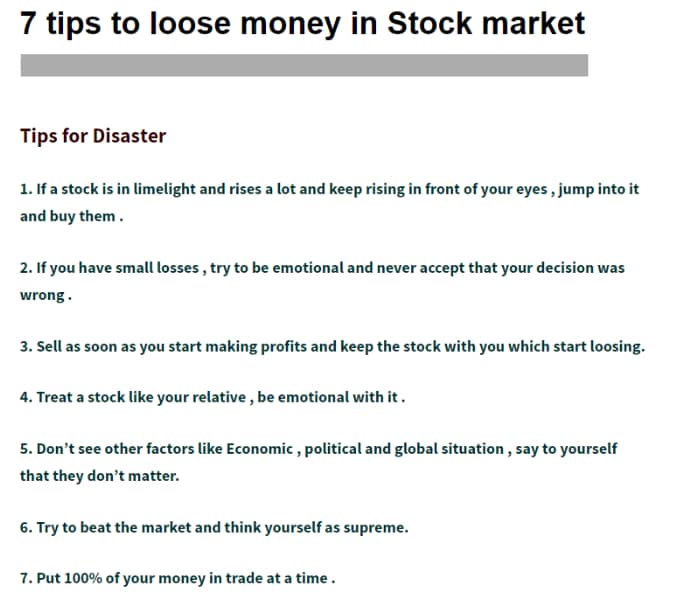
    Want to lose money, follow the tips!

    All are ready to win, no one wants to lose. If you follow the disaster tips by Jagoinvestor.com below, you are sure to lose your money in the stock market. Please beware of these issues.

    FAQs

    What percentage of investors lose?
    As per the references at home and abroad, around 90% of investors lose money in the stock market. The percentage is alarming but realistic. Such loss is fuelled by rumor-based trading, going for quick money, lack of investment literacy, impatience, behavioral biases, etc.

    Is it possible to beat the stock market?
    It is possible to beat the stock market, and 5-10% of investors do this tough job. Individual investors face hardship to win the stock market game.

    Why is it so hard to beat the market?
    Lack of knowledge and behavioral finance biases are the main odds to beat the stock market. Income taxes including the capital-gains tax rate, brokerage fees, annual account service fee, etc., may prevent beating the market easily.

    Is it worth taking investment advice?

    Stock market investing requires lots of experience and knowledge to master a successful strategy. Taking service from financial advisors or financial planners is worth the money.

  • Bond Market in Bangladesh | Complete database you need to know

    The effective bond market plays a vital role in the economic development of a country and presents long-term financing opportunities to the issuers by creating an alternative source of finance and provides a stable source of income to the investors. The bond market in Bangladesh will be presented with every bit of information you need to know.

    In Bangladesh, most of the debt financing need is fulfilled from the banking sources, which burdens the overall banking sector while presenting significant systemic risk. Therefore, the development of a well-functioning bond market would ensure financial stability by enhancing the ability of financial institutions to manage risks.

    Government Security: 

    Government Security is a tradable instrument issued by a sovereign Government. It acknowledges the Government’s debt obligation. Such securities are short-term (usually called treasury bills, with original maturities of less than one year) or long-term (usually called Government bonds or dated securities with an original maturity of one year or more).

    The Government borrows funds from domestic sources by issuing tradable and non-tradable securities to finance the budgetary deficits. 

    • Tradable T-Bills:14-day, 91-day, 182-day, and 364-day T-Bills;
    • Tradable T-Bonds: 2- year, 3-year FRTB, 5-year, 10-year, 15-year, and 20-year T-Bonds;
    • Non-tradable securities include Sanchayapatras and Prize bonds.

    Eligible Investors: Resident Individuals and institutions, such as banks, NBFIs, insurance companies, corporations, provident funds, pension funds, etc., can purchase and trade T-bills and T-bonds. However, foreign/non-resident individuals and institutions can invest only in T-bonds.

    As per the agreement between The Government of Bangladesh and Bangladesh Bank in 1985 (Treasury rules-1998 (Appendix-1, Section-3) and Bangladesh Bank (BB) Order-1972, article 20 empowers BB to issue new loans and manage public debt for the Government

    Features of Treasury Bills

    • The market determines the price
    • They are issued at a discount and redeemed at face value at maturity.
    • Tradable in the secondary market.
    • Issued in scriptless form.
    • The Central Bank releases a monthly calendar through the BB website.

    Features of Treasury Bonds

    • A risk-free fixed coupon-bearing debt instrument
    • Maturities are available within 2-20 years.
    • It carries a half-yearly coupon payment, and the principal is repaid on maturity.
    • The market determines yield.
    • Tradable instruments in the secondary market.
    • Issued in scriptless form.

    Participation in Auctions and Trading

    • Weekly (usually on Sunday) auctions of Treasury Bills are held following a pre-announced auction calendar with a specified amount. Bidders quote their prices. The Auction Committee determines the cut-off price from the offered prices.
    • Weekly (usually on Tuesday) auction of BGTB of a particular tenor is held following a pre-announced auction calendar with the specific amount. In case of a new issue, bidders quote their expected yields, and in re-issue auctions, they have to quote price.
    • Primary Dealers (PDs) can place bids in the auction. Other commercial banks and Non-Bank Financial institutions, Insurance companies, corporate, individuals, provident funds, etc., can also participate in the auction through PDs.
    • The minimum bid amount is Taka one lac, and its multiples.
    • Scheduled Banks and financial institutions maintaining accounts with Motijheel Office of Bangladesh Bank will take the initiative to open Business Partner Identification (BP ID) in favor of their individual/institutional customers. BP ID holders can access the Market Infrastructure (MI) Module of Bangladesh Bank to participate in the auctions. Individuals may also buy or sell government securities in the secondary market over the counter (OTC)/Trader Work Station (TWS) of the MI module.

    Benefits Can you derive by Investing Treasury Bonds

    • It is a risk-free investment since the sovereign Government issues it.
    • One can get an attractive rate of interest since the yield is determined in the market.
    • Since these bonds are tradable in the secondary market, one can obtain instant liquidity by selling them in the market.
    • All receipts of interest and maturity are fully repatriable in case of foreign investment.
    • One can get the best services from the Central Bank of Bangladesh, which maintains a fully automated scriptless depository system named Market Infrastructure (MI) Module.

    Evolution of the Government Securities Market in Bangladesh

    Year  Initiatives/Events  
    1972  Introduction of the issuance of 90-day (3-month) treasury bills (T-Bills) in August on a tap basis
    1995In October, treasury bills started being sold through auction at the market-determined rate
    1996Introduction of 30-day and 180-day treasury bills in February
    1997 In March, the auction of 1-year treasury bills was introduced
        1998Issuance of 30-day, 90-day, 180-day, and 1-year bills through weekly auctions In September, existing T-bills were replaced by newly introduced 28-day, 91-day, 182-day, 364- day
    2002Introduction of Central Bank Repo facility against T-bills Introduction of IB Repo facility against G-Sec
    2003Issuance of Bangladesh Government Treasury bonds (BGTB) Rules, 2003 in September Introduction of Primary Dealer (PD) system Issuance of 5-year and 10-year BGTBs
    2006  Introduction of auction calendar for the first time based on a deficit budget
    2007  Issuance of 15-year and 20-year BGTBs Introduction of liquidity Support (LS) to the PDs against government securities (G-Sec) Introduction of bidding commitments and underwriting obligations on PDs for T-bills and BGTBauctions Introduction of underwriting commission for the PDs
    2008Suspension of the issuance of the 28-day T-bills Introduction of mark-to-market requirements under the accounting framework for government securities (G-Sec)
    2009Introduction of automated delivery versus payment (DvP) settlement system
    2011Introduction of the Market Infrastructure (MI) Module for the automation of G-Sec management and operations
    2013Introduction of re-issuance of BGTBs Issuance of 2-year BGTB
    2014Issuance of the circular directing funded pension provident funds of banks to be invested in GSec
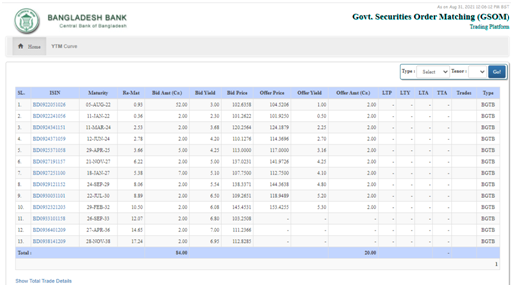
    2016Introduction of Government Securities Order Matching Trading Platform (GSOM) in August Introduction of 14-day T-bills
    2017Started publishing report on G-Sec on an annual basis (from FY 2016-17) Publication of Bangladesh Compound Rate (BCR) as a reference rate
    2018 Introduction of the secondary market yield curve (on a test basis)
        2019  Introduction of 3-Year Floating-Rate Treasury Bond (FRTB)   A working committee comprising members of BB, BSEC, and a commercial bank published the ‘Comprehensive Framework on the Development of the Bond Market in Bangladesh.’
    2020A strategic decision was taken to enlist G-Sec on DSE’s trading platform
    October 08, 2020Sukuk Guidelines2020‘ circulated by MoF
    December 28, 2020First Sukuk Bond issued
    December 02 2020Hiring Consulting Firm (National) for the Feasibility Study and Development of Guidelines on Green Sukuk for the Shariah Based Banks and Financial Institutions
    August 16, 2021  *On June 23, the Bangladesh Securities and Exchange Commission (BSEC) granted primary approval for the BEXIMCO Green-Sukuk with some conditions.   On July 8, the Bangladesh Securities and Exchange Commission gave the final approval to BEXIMCO for issuing a Tk 3,000-crore Shariahcompliant Sukuk. On August 16, Beximco’s Sukuk IPO subscription starts

    Types of Bond Market in Bangladesh 

    Government Securities (G-Sec) Market

    • Treasury Bills (T-Bills)
    • Treasury Bonds (T-Bonds)
    • Bangladesh Government Investment Sukuk

    At the end of FY 2019-20, the total outstanding of the Government’s borrowing from the banking sector stood at BDT 279,601.97 crore; Constituted 10.00% of the GDP (compared to 7.86% at the end of June 2019). The total outstanding amount of T-bills was 62,783.52 crore, and T-bonds were 216,818.45 crores.

    In FY 2019-20, the banking sector was the leading investor category, 

    • with 73.79% of the total outstanding of G-Sec; 
    • Long-term investors, like insurance companies and provident funds, accounted for 12.39% of the total holding; 
    • Bangladesh Bank held about 12.40% for its monetary operations. 

    Corporate Bonds

    • Governed by Bangladesh Securities and Exchange Commission (BSEC

    Corporate Bond Market 

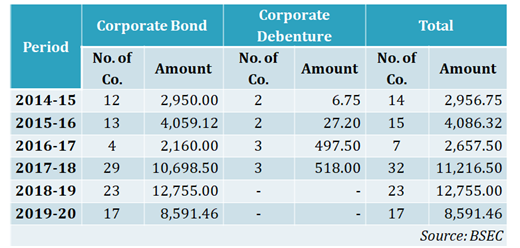
    BSEC governs the corporate bond market in Bangladesh. For issuing debt instruments through private offers, issuers are required to apply under the Securities and Exchange Commission (Private Placement of Debt Securities) Rules, 2012;

    The outstanding size of the public, the corporate bond market is insignificant compared to the G-Sec market. 

    Key Indicators of Corporate Bond Market: Private Offer 

    For debt instruments through public offers, Bangladesh Securities and Exchange Commission (Public Issue) Rules, 2015, Securities and Exchange Commission (Private Placement of Debt Securities) Rules, 2012 apply.

    Key Indicators of Corporate Bond Market: Public Issues 

    The outstanding size of the public corporate bond market is insignificant comparing to the G-Sec market. 

    Operation of G-Sec Market 

    Primary Market Operation 

    Debt Management Department (DMD) of Bangladesh Bank acts as the debt manager of the Government in consultation with the MoF; Cash and Debt Management Committee (CDMC) has been formed for the supervision of the Government’s borrowings chaired by Secretary, Finance Division;

    BB is authorized to conduct auctions for raising loans on behalf of the Government of Bangladesh. The process of raising loans involves the issuance of government securities. The Auction Committee, chaired by the Deputy Governor of BB, determines the cut-off rate of the auction of government securities. 

    Bangladesh Bank has its depository system for the transaction and settlement of Government securities in the Market Infrastructure (MI) Module. In 2011 BB introduced this automated system to expedite the primary auction and secondary market.

    Secondary market of Government securities

     Bangladesh Bank initiated Market Infrastructure (MI) Module to automate trading and settlement of Government securities transactions in October 2011. The secondary market of Bangladesh’s Government securities comprises Over the Counter (OTC) and Trader Work Station (TWS). Both the procedures are integral parts of the Market Infrastructure Module (MI Module)-government securities’ automated auction and trading platform.

     Over-the-Counter (OTC):

     Participants must submit a sale/buy order in the OTC platform while the counterparty confirms the order in the OTC market. Once they complete the trading process and the system accepts trades, the data automatically flows to Core Banking System (CBS) to clear and settle funds to achieve the settlement of funds in CBS. Further, the trading securities have been transferred automatically to the buyer securities account in MI.

     Trader Work Station (TWS):

     Bangladesh Bank has introduced the Trader Work Station (TWS)- an Order Matching system. The TWS is an electronic, screen-based, order-driven trading system for dealing in Government securities. In addition, the platform highlights the existing facility of the Over-The-Counter (OTC) market in Government securities. Further, the TWS brings transparency in secondary market transactions in Government securities. Members can place bids (buy orders) and offer (sell orders) directly on the TWS screen. The system is order-driven that matches all bids and offers, focusing on price/time. In particular, it matches the order on a first-come and first-serve basis among the similar price orders. In addition, the TWS facilitates Straight-Through-Processing (STP) system. In that system, trades are automatically sent to the CBS for settlement.

    Treasury/Government Securities (G-Sec) Management and Operational Process in Bangladesh

    1. Investment Process in Treasury Securities

    1.1. Investor’s Securities Account (Business Partner ID) Opening

    1.2. Investing in G-Sec via Banks and Financial Institutions

    1. Primary Market of G-Sec

    2.1. Auction of New Issuance

    2.2. Auction of Re-Issued Securities

    1. Secondary Market of G-Sec

    3.1. Anonymous Order-Matching System (OMS)

    3.2. Over-the-Counter (OTC)

    1. Open Market Operations

    4.1. Repurchase Agreements (Repo)

    4.1.1. Repo with the Central Bank

    4.1.2. Inter-Bank Repo

    4.2. Assured Liquidity Support (ALS) for Primary Dealers

    1. Trade Settlement Process via Core Banking Software (CBS)
    2. Report Generation and Management Functions in the MI Module

      Circular on Business Partner ID in MI Module

    Mi Module Functionalities

    Govt. Securities Order Matching (GSOM)

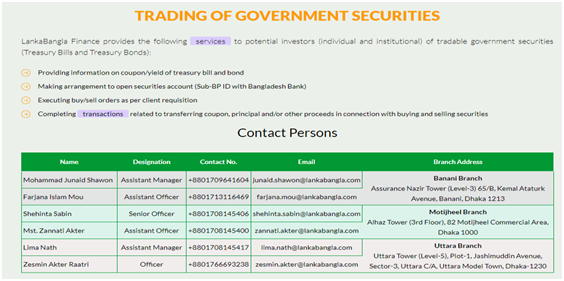
    Govt. Security Trading supports by Banks/NBFIs( Lanka Bangla Finance, for example)

    Challenges in G-Sec Market 

    • Proper Cash Management 
    • Introduction of a Medium-Term Auction Calendar 
    • A Large Number of Securities in the Market 
    • Absence of Established Pension/Provident Funds 
    • Proactive Market Making Activities by PDs
    • Prolonged Approval Period 
    • Lack of Debt Instruments Issued by Different Government Bodies 
    • Bonds Issued By Banks through Private Placement are Not Being Listed 
    • Overreliance on Bank Financing 
    • Absence of a Separate Trading Platform for Debt Securities 
    • Awareness Programs for the Investors and the Issuers

    The Prospects of a Vibrant Long-Term Bond Market in Bangladesh 

    All the aspects discussed below offer a massive prospect for an active, long-term bond market in Bangladesh: 

    Diversified Investment: A developed and diversified financial system with a sound debt and equity market enhances risk-pooling and better risk-sharing opportunities for investors and borrowers. The fixed-income securities market links the issuers having short and long-term financing needs with investors willing to place funds in short and long-term interest-bearing securities. In addition, it makes the financial market more competitive by generating market-based interest rates. 

    Flexibility: A well-functioning market offers the Government and the private investors the flexibility to diversify their funding sources and provides them with alternative sources of raising funds having different maturities. 

    Deficit Financing: An active market allows the Government to finance large fiscal deficits without resorting to financial repression or foreign borrowing. The drive to develop the government bond market typically comes from the Government to facilitate the financing of large fiscal deficits.

    Monetary Policy Implementation: The development of a well-functioning fixed-income market supports the efficient implementation of the monetary policy. It offers the instruments needed for the execution of monetary policy and improves the transmission mechanism of the monetary policy. Long-term bonds also facilitate the sterilization operations by the Central Bank as exclusive reliance on short-term instruments tends to drive up the short-term interest rates and encourage further inflows into such instruments. 

    Inflation Control: Developing a bond market, especially a vibrant G-Sec market, can improve access to local currency financing. An active G-sec market can offer local currency investors, such as retail and institutional investors, a way to invest in the local currency, and therefore, ensure better management of inflation and exchange rate risk. Also, a safe alternative investment compared to local currency bank deposits.

    Low-Cost Financing: The long-term fixed-income market, being accessible to foreign investors, increases financial integration by attracting foreign capital, which can lower the cost of borrowing for the Government and improve risk-sharing across countries. Moreover, the local currency government bond market can function as a catalyst for developing corporate bond markets by providing a benchmark yield curve. Similarly, derivatives markets cannot flourish without a well-developed fixed-income market with underlying assets.

    Less pressure on the Banking Sector: while the stock market capitalization of about 20% of the total financing requirement, 80% of debt financing comes from the banking sector. The banking sector cannot usually lend for longer than around five years, given that 70% of bank deposits are for one year or less. Funding long-term assets with short-term liabilities create a considerable maturity mismatch in the banking sector.

    Conclusion: 

    With the timely initiatives from Mof, BB, and BSEC, the Bond market in Bangladesh has taken a constructive shape. As a result, the Government can get the lion’s share of the budget deficit from securities. However, we still have miles to go to reach and exceed the international standards regarding the bond market. A vibrant and efficient bond market is crucial for a stable capital market with more comprehensive depth and capitalization. Besides, it shares the pressure on the money market and provides access to finance for long-term projects. Know all about credit cards here.