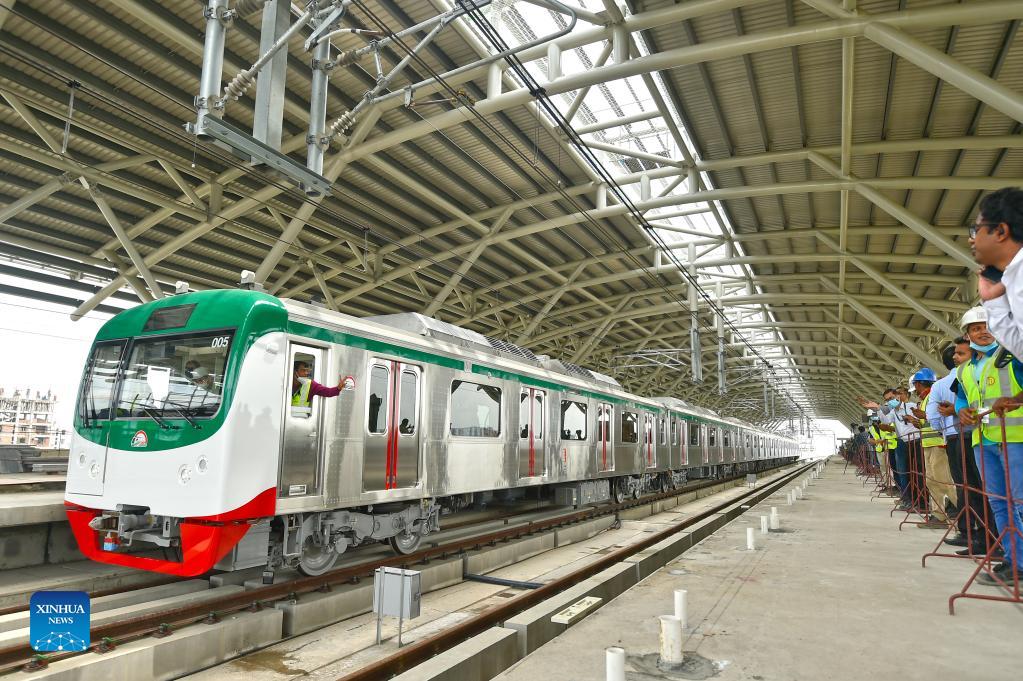
Metro Rail in Bangladesh is a planned rapid transit system in Bangladesh. It is also known as Mass Rapid Transit or MRT. The system has made the dream of Bangladeshis true with the partial opening of the MRT Line-6 on December 28, 2022, from Diyabari to Agargaon. The Agatgaon to Motijheel part opened on November 4, 2023 to experience a full metro journey.
It is the first such system in Bangladesh and one of only a handful in South Asia.
Dhaka Metro Rail Project Details
The MRT Line-6 project was given the go-ahead in 2012 with a June 2024 deadline and a cost of Tk 21,985 crore. The project was revised last year to extend the line to Kamalapur from Motijheel, and to procure land for some stations. The project cost went up to Tk 33,472 crore and the new deadline was set at 2025. Japan is providing about 60 percent of the cost as a soft loan. Japan International Cooperation Agency (JICA) are financers of the metro rail project.
Once in full service, MRT Line-6 will carry around 4.83 lakh people every day between Uttara and Motijheel. The trip will take 38 minutes, at a fare of Tk. 100. The first phase of the project is completed by 2023. The Diyabari to Agargaon part has been in operation since December 28, 2022, and the Agargaon to Motijheel part opened on November 4, 2023.
When finished, the metro rail system will consist of three lines with a total length of 33 kilometers (21 miles).
The Dhaka Metro Rail project is a proposed mass transit system that is planned to be developed in Dhaka, the capital city of Bangladesh. The project is intended to address the city’s growing transportation needs and improve mobility within the city.
The Dhaka Metro Rail project is being implemented by the Bangladesh Mass Transit Company Limited (BMTCL), a government-owned company. The project is being funded by the government of Bangladesh, as well as various international organizations, including the Japan International Cooperation Agency (JICA).
The proposed metro rail system would consist of two lines: Line 1 and Line 2. Line 1 is planned to be approximately 27 kilometers (17 miles) long and will run from Uttara in the north to Motijheel in the south. Line 2 is planned to be approximately 24 kilometers (15 miles) long and will run from Mirpur in the west to Abdullahpur in the east.
Metro Rail Factfile
- Dhaka Metro Rail Project total cost of Tk 33,472 crore
- Officially known as the Mass Rapid Transit (MRT) Line-6
- Capacity to carry about 60,000 passengers/hour
- 20.26 km from Uttara to Kamalapur wi 17 stops
- It will take around 38 minutes from nUttara to Kamalapur
- JICA provides around 60% of the fund
- The metro rail will have 17 stations for MRT-6
- The 12km track of the first part stretches from north Uttara to Agargaon.
- The second phase, which will be from Agargaon to Motijheel, will be complete by December 2023.
- The metro rail will have noise barriers and vibration-free tracks and thus be environment-friendly
- The project is being implemented by government-owned Dhaka Mass Transit Company Ltd while Dhaka Transport Coordination Authority is supervising
Metro Rail Timeline
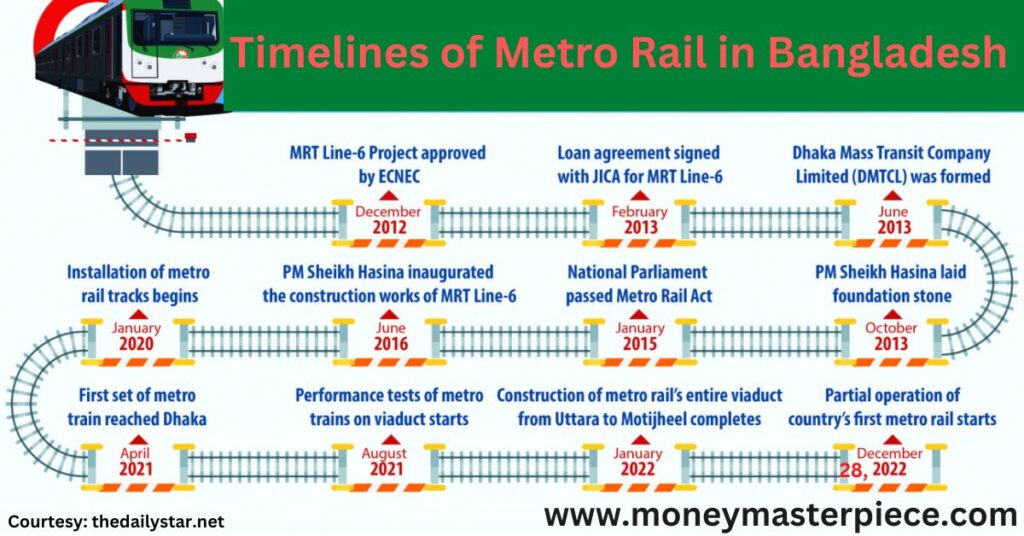
- In December 2012, the Executive Committee on National Economic Council (ECNEC) approves the Metro Rail scheme.
- In February 2013, loan agreement with JICA.
- On November 30, 2014, Metro Rail Bill 2014 placed at the parliament
- On March 27, 2015, the government signed a contract with Japanese Tokyu Construction Company for Metro Rail depot.
- On June 26, 2016 Prime Minister Sheikh Hasina inaugurated .
- On May 3, 2017, signed three contracts with two companies for the civil construction work
- On August 1, 2017, The authorities gave the work order to the contractors
- On August 2, 2017 Road Transport and Bridges Minister Obaidul Quader inaugurated construction of the first part of the elevated railway
- On 29 August 2021, MRT Line-6’s train made its first run
- On December 28, 2022, Prime Minister Sheikh Hasina inaugurated the operations of the Uttara to Agargaon part
- On November 4, 2023, Prime Minister Sheikh Hasina inaugurated the operations of the Agargaon to Motijheel part
What is Meant by Metro Rail?
Metro rail, also known as a metro, subway, or underground rail, is a type of mass transit system that operates on a fixed schedule and transports large numbers of people within urban areas. Metro rails typically consist of a network of tracks and stations, with trains that run underground or above ground to transport passengers from one part of the city to another. Metro rails are typically powered by electricity, and they are often used as an alternative to buses and other modes of transportation for commuting to work or other destinations within a city. Metro rails are often seen as a more efficient and convenient way to travel, as they can help to reduce traffic congestion on the roads and provide a reliable and quick way for people to get around.
A metro rail, or subway system, is a rapid transit system that runs underground or elevated. It is usually found in larger cities and metropolitan areas. The first metro rail systems were built in the early 1900s. Today, there are many different types of metro rail systems around the world.
Is There a Metro Rail in Bangladesh?
Yes, there is a metro rail in Bangladesh. It started operations on December 28, 2022. The country’s capital, Dhaka, has a population of over 18 million people and is one of the most densely populated cities in the world. The city suffers from severe traffic congestion and pollution, and a metro system would help to alleviate these problems.
What is the Purpose of Metro Train?
The purpose of a metro train system, or subway system, is to provide a convenient, efficient, and environmentally friendly means of public transportation within densely populated urban areas. Metro train systems are designed to address several key objectives:
- Mass Transit: Metro trains are a form of mass transit that can move a large number of people quickly and efficiently. They help reduce traffic congestion on city streets and highways, making urban transportation more sustainable.
- Accessibility: Metro systems provide an accessible and convenient mode of transportation for residents and commuters. They serve as an alternative to driving a personal vehicle, promoting a more sustainable and efficient means of getting around.
- Connectivity: Metro train networks connect various parts of a city, making it easier for people to reach their destinations. They often link major residential areas, business districts, educational institutions, and entertainment hubs, allowing passengers to travel easily from one point to another.
- Reduced Environmental Impact: Metro systems are generally more environmentally friendly compared to individual car use. They produce fewer greenhouse gas emissions, reduce air pollution, and help combat climate change by offering an alternative to fossil fuel-powered vehicles.
- Economic Benefits: Metro systems can stimulate economic growth by improving accessibility to businesses and job centers. They also reduce the cost of road maintenance and lower the burden on the transportation infrastructure.
- Time Efficiency: Metro trains are known for their punctuality and reliability, which helps passengers save time during their daily commute. They can avoid traffic congestion and arrive at their destinations more predictably.
- Safety: Metro systems are often designed with safety in mind, including features like automated train control systems, emergency exits, and surveillance cameras. This makes them a safe mode of transportation.
- Reduced Energy Consumption: Metro trains are energy-efficient due to the use of electricity and regenerative braking systems. This reduces overall energy consumption and reliance on fossil fuels.
- Reduced Noise Pollution: Compared to road traffic, metro systems tend to generate less noise pollution, making urban areas more livable for residents.
- Public Health: Encouraging the use of metro systems can lead to improved public health by reducing air pollution and traffic-related health issues. Additionally, the opportunity for walking to and from metro stations promotes physical activity.
- Reduced Congestion: Metro systems help alleviate traffic congestion, especially in large and densely populated cities. By encouraging people to use public transportation, they reduce the number of private vehicles on the road.
Why Metro Rail is Needed in Bangladesh?
Bangladesh is one of the most densely populated countries in the world, with a population of over 160 million people living in an area of just under 150,000 square kilometers. The country’s capital, Dhaka, is also one of the world’s most populous cities, with a population of over 18 million people. The city is plagued by traffic congestion and pollution, and suffers from regular gridlock.
A metro rail system would help to alleviate some of these problems by providing a fast and efficient way to move large numbers of people around the city. The first step in developing a metro rail system for Dhaka would be to conduct a feasibility study to identify potential routes and stations. Once this was done, construction could begin on the infrastructure needed to support the system.
This would include building underground tunnels or elevated tracks, as well as constructing stations and maintenance facilities. The cost of such a project would be significant, but it would be offset by the many benefits that a metro rail system would bring to Bangladesh’s largest city.
There are several reasons why a metro rail system may be needed in Bangladesh. Some of the potential benefits of a metro rail system in Bangladesh could include:
- Reducing traffic congestion: A metro rail system can help to reduce traffic congestion on the roads, as it can provide an alternative mode of transportation for commuting to work or other destinations within a city.
- Improving air quality: Metro rail systems typically run on electricity, which means that they do not emit any harmful emissions. This can help to improve air quality in urban areas, particularly in cities where air pollution is a problem.
- Enhancing economic development: A metro rail system can help to stimulate economic development in a city by providing access to new job opportunities and facilitating the movement of people and goods within the city.
- Improving accessibility: Metro rail systems can help to improve accessibility for people with disabilities or mobility challenges, as they often have features such as elevators and ramps to make it easier for people to access the trains.
- Providing a reliable mode of transportation: Metro rail systems are typically more reliable than other modes of transportation, as they run on a fixed schedule and are less prone to delays due to traffic congestion. This can make them a more attractive option for commuting to work or other destinations.
- Population density: Bangladesh is a densely populated country, with a population of over 160 million people. This high population density can lead to traffic congestion and other transportation challenges, making it difficult for people to get around efficiently. A metro rail system could help to alleviate some of these issues by providing an alternative mode of transportation for commuting and other travel within urban areas.
- Traffic congestion: Bangladesh’s major cities, such as Dhaka and Chittagong, are known for their heavy traffic and congestion, which can make it difficult for people to get around and can also contribute to air pollution. A metro rail system could help to reduce traffic congestion by providing an alternative mode of transportation that is faster and more efficient.
- Environmental benefits: In addition to reducing traffic congestion, a metro rail system could also have environmental benefits by reducing air pollution and greenhouse gas emissions. Metro rail systems are often powered by electricity, which can be generated from renewable energy sources, making them a more sustainable transportation option.
FAQs on Metro Rail in Bangladesh
How much is the Dhaka metro rail project?
The Metro Rail project cost is revised at Tk 33,472 crore. The original cost estimation was for Tk 21,985 crore.
Who is funding Dhaka Metro Rail?
The Japan International Cooperation Agency (JICA) has provided around 60% of the Tk 33,472 crore (Revised costs) funding and technical assistance for the MRT Line-6. The other portion comes from the government.
What is the minimum fare for Dhaka Metro rail?
The minimum fare has been set at Tk. 20 for Dhaka Metro rail.
When did metro rail start in Bangladesh?
Bangladesh entered the age of metro rail on December 28, 2022.
Which country first used the metro?
The UK’s London Underground was originally opened in 1863 for locomotive trains. In 1890, it became the world’s first metro system when electric trains started operations.
Conclusion
Metro Rail Bangladesh is a rapid transit system serving the Dhaka metropolitan area. It is operated by the Bangladesh Railway and consists of two lines: the Red Line and the Blue Line. The Metro Rail network has a total length of 33 km and serves 37 stations.