
Author: MMP

  • How Does Sports Marketing Impact the Economy?

    How Does Sports Marketing Impact the Economy?

    Here is a detailed and SEO-friendly blog post on:


    How Does Sports Marketing Impact the Economy?

    Sports have long been more than just games—they are powerful economic engines that shape industries, create jobs, and influence consumer behavior. At the heart of this economic force is sports marketing, a dynamic field that blends entertainment, advertising, and commerce. From multimillion-dollar sponsorship deals to viral social media campaigns, sports marketing touches nearly every corner of the global economy.

    But how exactly does sports marketing influence economic activity? In this article, we’ll break down the multifaceted impact of sports marketing on the economy—from job creation and brand revenue to tourism and technology innovation.


    What is Sports Marketing?

    Sports marketing refers to the strategies and tactics used to promote sports events, teams, athletes, or products and services through sports. It includes:

    • Sponsorships and endorsements
    • Advertising during sports broadcasts
    • Social media and digital campaigns
    • Merchandise and branding
    • Event promotions and fan engagement

    Its dual focus is to:

    1. Promote sports teams or events.
    2. Market non-sports products through sports platforms.

    1. Job Creation and Industry Growth

    Sports marketing is a major employer across several sectors:

    Direct Employment

    • Marketing managers
    • Brand strategists
    • Digital content creators
    • Sponsorship coordinators
    • Event planners

    Indirect Employment

    • Advertising agencies
    • Media production companies
    • Stadium and arena staff
    • Merchandising and retail workers

    Example:

    When a major event like the Super Bowl or the FIFA World Cup takes place, thousands of temporary and permanent jobs are created in marketing, hospitality, media, and logistics.


    2. Boost to Consumer Spending

    Sports marketing campaigns are designed to drive purchases—from tickets to jerseys to soft drinks. As fans respond emotionally to teams and athletes, they’re more likely to:

    • Buy merchandise
    • Subscribe to sports channels
    • Visit sponsored venues
    • Try endorsed products

    Real-World Example:

    Nike’s partnership with Michael Jordan led to the creation of the Air Jordan brand, which now generates over $5 billion annually, proving the long-term power of athlete endorsements.


    3. Sponsorship and Brand Value

    Brands invest billions into sports sponsorships to gain visibility, trust, and customer loyalty. In return, this fuels:

    • Revenue for sports teams
    • Increased brand equity for sponsors
    • Innovation in marketing strategies

    Key Stats:

    • Global sports sponsorships surpassed $80 billion in 2024, according to industry estimates.
    • Companies like Coca-Cola, Adidas, and Visa have seen significant boosts in global brand awareness through Olympic and FIFA World Cup sponsorships.

    4. Economic Development in Host Cities

    Large-scale sports events supported by marketing campaigns attract tourists, investors, and global attention. This translates into:

    • Increased hotel occupancy
    • Restaurant and retail sales
    • Airport traffic
    • Local business growth

    Example:

    The 2012 London Olympics were heavily marketed and generated an estimated £2.1 billion in economic benefit for the UK in the year following the event.


    5. Media and Technology Innovation

    Sports marketing fuels advancements in:

    • Streaming technology (e.g., ESPN+, DAZN)
    • AR/VR fan experiences
    • Data analytics and AI in advertising
    • E-commerce platforms

    These innovations often spill into other industries, creating cross-sector economic benefits.


    6. Growth of Small Businesses and Entrepreneurs

    Sports marketing also supports smaller players:

    • Local apparel brands partnering with high schools or minor league teams
    • Independent content creators monetizing sports blogs and YouTube channels
    • Sports influencers creating branded content

    This decentralized impact helps grow local economies and digital entrepreneurship.


    7. Long-Term Brand Loyalty and Lifetime Customer Value

    Effective sports marketing doesn’t just result in short-term purchases—it builds lifelong brand loyalty.

    • Fans who associate positive emotions with a brand sponsor are more likely to buy that brand repeatedly.
    • This consistent purchasing behavior translates to long-term economic activity and steady growth for companies.

    8. Social and Cultural Influence with Economic Results

    Marketing campaigns that promote inclusivity, mental health, or community development can lead to:

    • Increased community support and participation in sports
    • Better health outcomes (reducing public healthcare costs)
    • More youth engagement (stimulating future athletic and economic productivity)

    Campaigns like Nike’s “You Can’t Stop Us” or the WNBA’s social justice initiatives have had cultural and economic ripple effects far beyond sports.


    9. Multiplier Effect in Local Economies

    The multiplier effect describes how one dollar spent in sports marketing (such as advertising or event promotions) circulates through the economy multiple times.

    Example:
    A brand sponsors a local marathon → The event hires local vendors → Vendors buy supplies from local businesses → Employees spend wages at neighborhood stores.

    This ripple effect strengthens small business ecosystems and boosts GDP contributions.


    Challenges and Criticism

    While sports marketing drives economic activity, it’s not without downsides:

    • Over-commercialization can alienate fans.
    • Disparity in funding between men’s and women’s sports persists.
    • Short-term economic boosts from events may not always translate into long-term development unless planned well.

    Understanding these limits is important for creating responsible and equitable sports marketing strategies.


    Final Thoughts: A Game-Changer for the Economy

    Sports marketing is more than a flashy commercial or a logo on a jersey. It’s a powerful economic tool that generates billions in revenue, creates jobs, drives innovation, and influences how we spend our money. Its impact stretches from global corporations to local entrepreneurs, from stadiums to streaming platforms, and from the sports fan in the stands to the small business owner down the street.

    Whether you’re a student, a marketer, or simply a curious fan, understanding the economic engine behind sports marketing offers valuable insight into how passion for the game powers real-world financial growth.

  • Why Invest in Bangladesh?

    Bangladesh is often seen as a large domestic market with a population of 180 million people, but in reality, it is far more than just a local market. It is a regional and global story in the making. The country is evolving rapidly and positioning itself as a major player in the global economy, with an eye on becoming a logistics and investment hub in the coming years. So, why should investors take notice of Bangladesh? Let’s explore the reasons why investing in Bangladesh is not just about economic gains but also about being part of a transformational journey.

    A Strategic Regional and Global Market

    While Bangladesh has a large population, the real opportunity lies in its strategic location and the ongoing efforts to turn it into a logistics and trade hub for the region. The government is actively working to enhance port capacities, particularly in the Chittagong area, with plans to triple the existing capacity in the next few years. This expansion will not only cater to Bangladesh’s domestic needs but will position the country as one of the biggest logistical hubs in the region, making it an essential link between South Asia and the rest of the world.

    Listening to the Business Community

    The government’s commitment to improving the business climate in Bangladesh is evident from the steps taken by the interim government, which has engaged with over 200 CEOs and entrepreneurs who are currently doing business in the country. These business leaders have become valuable voices in shaping the future of Bangladesh’s economy. The government has taken their concerns and complaints seriously, using them as a basis for reform and growth.

    Rather than simply addressing the issues, the government has focused on transforming critics into ambassadors. These are the people who can help bring in more business by promoting Bangladesh as a great place to invest when they travel abroad. By focusing on practical solutions and setting a direction for the future, Bangladesh is fostering an environment where businesses can thrive.

    One-Stop Service and Relationship Management

    One of the major complaints from investors has been the complexity of the process involved in doing business in Bangladesh. To address this, the government has rolled out a number of initiatives to streamline these processes. A key example is the creation of a “true one-stop service” that combines both human and digital elements to simplify business procedures.

    The human element focuses on collocating key agencies in one office, allowing investors to meet all relevant authorities in one place. This eliminates the need to visit multiple ministries, making the process much smoother. Additionally, a relationship management team under the Bangladesh Investment and Trade Authority (BIDA) has been set up, similar to a corporate banking relationship manager. This team guides investors through every step of the process, ensuring that their needs are met and their concerns addressed promptly.

    Fast-Tracking Customs and Logistics

    Bangladesh has also made significant strides in improving its customs procedures, with the help of the National Board of Revenue. One of the key initiatives has been the establishment of the Authorized Economic Operator (AEO) program, which is essentially a “green channel” for reliable, trusted businesses. Under this system, businesses that meet certain criteria are able to fast-track their shipments through customs, reducing delays and enhancing the efficiency of supply chains. This initiative addresses one of the biggest challenges for businesses in Bangladesh: the time it takes to move goods from factories to customers.

    Bridging the Gap Between Government and Private Sector

    A recurring challenge in many countries, including Bangladesh, is the lack of dialogue and cooperation between the government and the private sector. In Bangladesh, however, the government is taking steps to address this issue by creating a more collaborative environment. One of the most exciting developments is the plan to establish a Private Sector Advisory Council. This council will act as a direct link between the private sector and the head of state, allowing for regular communication and input from business leaders. This initiative will help ensure that the private sector’s voice is heard and that the government’s policies align with the needs of businesses, creating a more conducive environment for investment and growth.

    A Vision for 2035: Transforming Bangladesh

    The government of Bangladesh has a clear vision for the country’s future, and this vision extends well beyond the next few years. By 2035, Bangladesh aims to be a top destination for investment, with world-class infrastructure, efficient logistics, and a thriving business ecosystem. But the path to this future is not just about economics. It is about being part of a broader transformational journey.

    Investing in Bangladesh means being part of a country that is rapidly evolving, not just in terms of economic growth but also in terms of cultural transformation and the resilience of its people. Bangladesh’s warm and welcoming culture, combined with the shared values of its people and international investors, creates a unique environment for long-term growth.

    Why Invest in Bangladesh Beyond the Economics

    While the economic reasons to invest in Bangladesh are compelling—such as a growing economy, favorable demographics, expanding infrastructure, and government reforms—the true value lies in the transformational journey you can be a part of. Bangladesh’s people are known for their warmth, resilience, and determination, qualities that make this country not only an attractive place to do business but also a place where meaningful connections can be made.

    As Bangladesh continues to strengthen its logistics, policy framework, and business environment, it is poised to become a key player in the global economy. Whether you are looking to tap into its vast market, take advantage of its strategic location, or be part of a growing and dynamic nation, investing in Bangladesh offers an opportunity to make a significant impact while achieving sustainable business success.

    Ready to Take the Leap?

    There are many reasons to invest in Bangladesh, and the government is committed to making the country even more attractive for investors. The next step is simple: if you want to learn more about the potential of investing in Bangladesh, keep an eye out for the QR code that will lead you to further details and statistics. You can download this presentation, along with an appendix that outlines why Bangladesh is in a strong competitive position compared to its regional competitors.

    But ultimately, the decision to invest in Bangladesh is about more than numbers and data—it’s about joining a country on a journey of growth, transformation, and global connectivity. Now is the time to be part of something extraordinary.

  • Chief Adviser at the Bangladesh Investment Summit 2025

    Here’s an extensive and engaging blog post based on the powerful speech delivered by Professor Dr. Muhammad Yunus, the Chief Adviser to the interim government, at the Bangladesh Investment Summit 2025:


    From Famine to Fortune

    On a warm 9th April in 2025, at the InterContinental Hotel in Dhaka, the Bangladesh Investment Summit unfolded as more than just a business gathering—it became a stage for reflection, inspiration, and a call to action. The summit’s highlight? A heartfelt, visionary address by Nobel Laureate and Grameen Bank founder, Professor Dr. Muhammad Yunus.

    Dr. Yunus, known for revolutionizing microcredit and for championing social business, took the audience on a soul-stirring journey—one that connected the darkest days of Bangladesh’s past to its shining future. Here are the key themes and transformative ideas from his speech that left the entire hall teary-eyed and standing in ovation.


    A Journey of Pain and Triumph: From 1971 to 2025

    Yunus began his speech welcoming the honorary Bangladesh citizen Kihak Sung and acknowledging the heroes of Bangladesh—entrepreneurs, innovators, and everyday citizens who have driven the country’s progress. He took the audience back to 1971, when Bangladesh emerged as an independent nation after a brutal war.

    Dr. Yunus began by paying homage to the heroes of Bangladesh’s long struggle. With visible emotion, he recalled the euphoria of independence in 1971—a time of hope after immense sacrifice. But that hope was soon followed by the tragedy of 1974’s famine, where 1.5 million people died of hunger.

    That year, the country was synonymous with the term “dirt poor.” Farmers dominated the population, but three-quarters were landless. Life was fragile, survival a daily struggle.

    Fast forward to 2025, and the transformation is astounding.

    “We were once a country of landless farmers, now we talk of tech, factories, and startups,” said Dr. Yunus. “Bangladesh has come a long way—fueled by courage, compassion, and crazy ideas.”


    From Microcredit to Global Impact

    One such “crazy idea” was microcredit—a small act of lending tiny amounts to impoverished women. What started in a small village as a humble initiative became Grameen Bank, now a global symbol of financial inclusion.

    “Every country has its own Bangladesh of 1974 inside,” Dr. Yunus noted. “The solution isn’t charity. It’s creating structures that unleash human energy.”


    How Bangladesh Changed the Telecom World

    Another audacious leap was into mobile phones. At a time when Bangladesh had barely any working telephone lines, Dr. Yunus applied for a mobile telecom license—not to profit, but to empower women. Everyone laughed.

    But he persisted, partnering with Norway’s Telenor to launch GrameenPhone, which revolutionized rural connectivity through “Telephone Ladies”—poor, often illiterate women who sold mobile services in villages.

    “They had never even seen a phone. We trained them. And soon, 100,000 women were in business, connecting families, growing incomes, and changing perceptions.”

    The global mobile industry took notice. Bangladesh had rewritten the rules—and changed the game.

    From Garments to Global Startups

    Bangladesh is now the world’s second-largest garment exporter, but Yunus emphasized that the future lies beyond textiles.

    He celebrated ShopUp, a Bangladeshi startup that recently secured $110 million from Saudi Arabia’s PIF and Peter Thiel’s Valor Ventures, signaling the rise of a tech-driven economy.


    Business with a Soul: Profit + Purpose

    Dr. Yunus reminded the audience—comprising investors, CEOs, policymakers, and changemakers—that profit alone is not the ultimate goal. The new path is business with social purpose.

    “Making money is happiness. But making others happy is super happiness.”

    He urged entrepreneurs to dream bigger: to build companies that solve real problems, empower people, and reshape society.


    Three Zeros: The Blueprint for a New Civilization

    Dr. Yunus presented his bold vision: a civilization built on Three Zeros:

    1. Zero Carbon Emissions – “A self-destructive world must stop burning itself. Businesses must lead the innovation.”
    2. Zero Wealth Concentration – “Extreme wealth inequality is the most dangerous thing to humanity.”
    3. Zero Unemployment – “Everyone can be an entrepreneur. Young people don’t want jobs—they want to create!”

    This isn’t a government-led revolution, he emphasized. It’s up to individuals and businesses to bring this world into reality.


    The Next Generations: Time to Pass the Baton

    Dr. Yunus acknowledged the trailblazing first-generation entrepreneurs who defied odds in the 60s and 70s. Today, the second generation—and soon, the third—are ready to build on that legacy.

    “Are we preparing the third generation? The young girls and boys with ideas and technology, who are not bound by the old ways?”

    He stressed the importance of involving women in entrepreneurship, calling them equally creative and vital to economic and social progress.


    Bangladesh: A Seedbed of Global Ideas

    Bangladesh, according to Dr. Yunus, isn’t just a developing economy—it’s a fertile ground for global transformation.

    Microcredit, born in a small Bangladeshi village, now flourishes in the United States. Through Grameen America, millions of women receive loans—some as little as $500—and build better lives.

    “We planted a small seed in Bangladesh. Today, it’s growing worldwide. Your business could be next.”


    A Call to Investors: Build Here, Grow Globally

    The summit wasn’t just a reflection. It was an invitation.

    “If you want to build businesses with purpose, come to Bangladesh. You’ll find happiness and super happiness. This isn’t just about Bangladesh—it’s about creating a better world.”


    Bangladesh 2035: A Regional Manufacturing & Logistics Hub

    Yunus outlined a bold vision for 2035, where Bangladesh will be:
    A regional manufacturing powerhouse
    A bridge connecting the Himalayas to the Bay of Bengal
    A global logistics hub (with Chittagong Port’s capacity tripling)

    Why Invest in Bangladesh?

    ✔ 180 Million Consumers – A young, dynamic population (half under 25)
    ✔ Rising Middle Class – 35 million people (equivalent to Malaysia’s entire population)
    ✔ Proven High Returns – Companies operating in Bangladesh for 100+ years have seen exceptional profits
    ✔ Strategic Location – A gateway to South and Southeast Asia

    Create the World We Want

    Dr. Yunus concluded with a message for all who dream of changing the world:

    “We don’t need to wait for governments. We, the people, can change the world. Business gives us the most powerful tool in our hands. Let’s use it to build a civilization of Three Zeros.”

    His words echoed in the hall long after he left the stage. Hope, vision, courage—these were not just ideals. They were blueprints. And Bangladesh, once a symbol of famine, now stands as a beacon of possibility.

    Let’s not just do business in Bangladesh. Let’s build a new world—from here.

  • Journey of Kihak Sung in Bangladesh

    When Kihak Sung, a young South Korean entrepreneur, first landed in Chattogram in 1979, Bangladesh was far from an ideal business destination. The infrastructure was inadequate, foreign investment was heavily restricted, and political instability loomed large. But what the country lacked in systems, it made up for in opportunity. Bangladesh’s quota-free access to European markets made it an attractive alternative for Korean exporters burdened by trade restrictions in the developed world.

    While many Korean companies were considering India, Sri Lanka, or Pakistan, Kihak Sung made a bold choice—he picked Bangladesh.

    The Humble Beginning: Youngone in 1980

    In May 1980, Sung partnered with local businessmen and established Youngone Bangladesh Limited. The venture began with modest resources—a small factory, just 250 workers, and a favorable first order from a Swedish buyer. Materials were hauled by hand carts from the port, forming kilometer-long queues. But despite the initial hardships, the operation flourished.

    By 1984, Youngone was exporting $18 million worth of garments, proving that Sung’s bet on Bangladesh was more than just a gamble—it was the start of a new industrial chapter.

    Rising Against the Odds

    The early years weren’t without struggle. Political protests outside the factory, labor disputes within, and a challenging partnership dynamic led Kihak Sung to buy back the shares of his Bangladeshi partners in 1986. That same year, he relocated operations to the newly built Chittagong Export Processing Zone (CEPZ), seeking better infrastructure and stability.

    Despite a slow start, Youngone steadily expanded in the CEPZ. The company rented multiple factory spaces and grew its capacity. An IPO in Korea in 1988 improved cash flow, enabling further investment—including a sprawling 100,000 sq ft factory by 1990.

    But then disaster struck.

    Surviving the Storm: 1991 Cyclone

    In April 1991, a super cyclone ravaged the coastal areas of Chittagong, killing over 138,000 people and devastating Youngone’s facilities. Floodwater covered the factories; mud and debris rendered them unusable. Sung stayed behind to help salvage the operation. What he witnessed during that time changed his perspective.

    “The workers wanted their jobs and were determined to keep us in Bangladesh. When I left after the recovery, they cried,” Sung recalled in an interview.

    This emotional connection solidified Sung’s long-term commitment to Bangladesh. Orders poured in from buyers who admired Youngone’s resilience, and the company began to thrive like never before.

    Vision for the Future: The Birth of Kepz

    As Youngone expanded, CEPZ’s limitations became apparent. It couldn’t keep up with the scale and speed of Sung’s ambitions. The idea of a private Export Processing Zone took root during a JICA (Japan International Cooperation Agency) programme in the mid-90s, which proposed a new furniture EPZ in Anwara.

    Encouraged by the Korean ambassador and inspired by the opportunity, Sung decided to take the lead.

    What he found in Anwara was far from ideal—arid, sandy land often referred to as “Texas” by locals due to its dry, barren landscape. Water was scarce, and during the monsoons, the area flooded. But Sung saw beyond the obstacles.

    By 1999, the government had acquired 2,500 acres of land for the Korean Export Processing Zone (Kepz). However, bureaucratic red tape slowed progress. Despite investing over Tk 100 crore, Youngone had to wait years for licenses, environmental clearance, and land mutation documents. But Sung remained undeterred.

    Kepz: A Model Industrial Zone

    In 2008, construction finally began. By 2011, the first factories became operational. Kepz introduced innovative water conservation methods, including rainwater harvesting and massive artificial water bodies capable of storing 500 million gallons annually. This not only provided sustainable water for operations but also protected surrounding villages from seasonal flooding.

    Today, Kepz stands as a testament to Sung’s commitment to green, productive industry. With 50% of the land preserved for greenery, Kepz is envisioned as more than just a factory zone—it is a vibrant urban ecosystem built for healthy living and sustainable work.

    “I cannot go away with Kepz,” Sung said. “I want to make it one of the best places to live and work.”

    A Lasting Legacy

    Today, Youngone Corporation employs around 90,000 people globally—72,000 of them in Bangladesh. The company is listed on the Seoul Stock Market, generating $2.5 to $3 billion in annual revenue, one-third of which comes from its Bangladesh operations.

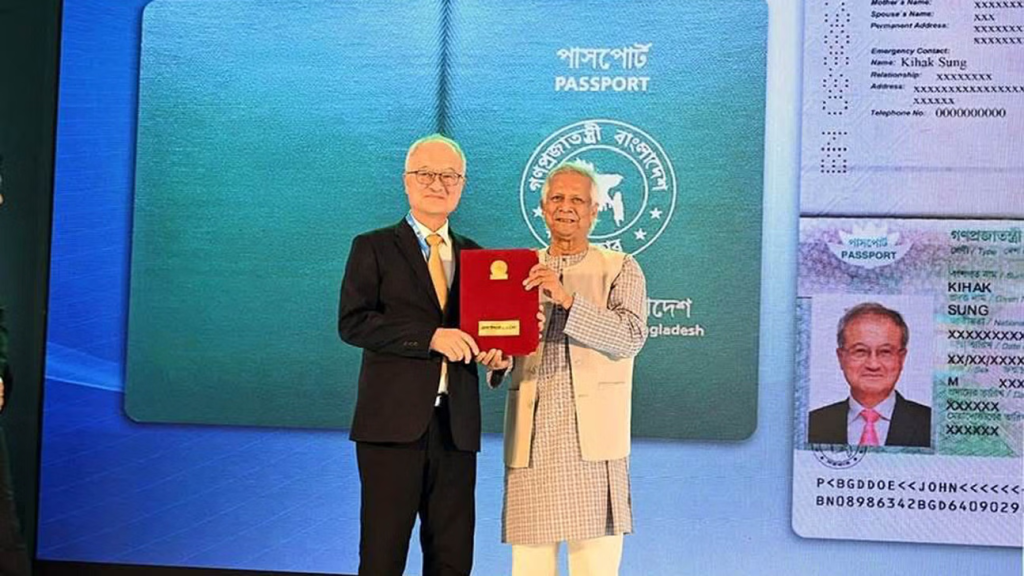
    Beyond business, Kihak Sung’s contributions were recognized at the Bangladesh Investment Summit 2025, where he was awarded honorary citizenship by Chief Adviser Dr. Muhammad Yunus—a fitting tribute to a man who gave decades of his life to build what few dared to imagine.

    Honorary citizenship of Bangladesh

    Kihak Sung, Chairman of Youngone Corporation and a trailblazer in Bangladesh’s readymade garments (RMG) and textile sectors, was awarded honorary citizenship on April 9, 2025, in recognition of his exceptional contributions to the nation’s economy and industrial growth.

    The honorary citizenship document was formally presented by Chief Adviser Professor Muhammad Yunus during the Bangladesh Investment Summit 2025, held at the InterContinental Hotel in Dhaka.

    Sung was among five distinguished individuals and organizations honored for their impactful roles in shaping Bangladesh’s development trajectory. Reflecting on the recognition, Sung expressed heartfelt appreciation: “I am truly honoured to receive this honorary citizenship.”

    Born in 1947 in Seoul, Sung earned his degree in international economics from Seoul National University before entering the world of global trade through Seoul Trading. This early exposure to international markets paved the way for his entrepreneurial journey and ultimately, his long-standing partnership with Bangladesh.

    Last Lines


    Kihak Sung’s story is not just about business success—it’s a story of resilience, foresight, and unwavering belief in people. It reminds us that transformative change often begins with a bold idea, nurtured through years of grit, guided by vision, and carried out with heart.

    Bangladesh’s garment industry might have many heroes—but in the chronicles of industrial progress, Kihak Sung’s name will forever shine as a pioneer who turned dreams into factories, and factories into futures.

  • BIDA Chief Mr. Ashik at the Bangladesh Investment Summit 2025

    Here’s an extensive blog post based on Mr. Ashik Chowdhury’s keynote at the Bangladesh Investment Summit 2025. The speech got a tremendously positive vibe by the netizens.

    In an electrifying keynote at the Bangladesh Investment Summit 2025, Mr. Ashik Chowdhury, Executive Chairman of both the Bangladesh Investment Development Authority (BIDA) and the Bangladesh Economic Zones Authority (BEZA), delivered a passionate, bold, and forward-thinking message to investors across the globe: “We are open for business — and we are here to win.”

    From the very first words — a double “Good Morning!” delivered with humor and warmth — to the closing remarks that blended data with emotion, Mr. Chowdhury made it clear that Bangladesh is not just inviting investment. It’s rewriting its narrative.


    A Full House and Overflowing Optimism

    Apologizing with a smile for the overbooked accommodations, Mr. Chowdhury pointed out the overwhelming interest in the summit as a “great problem to have.” The room was buzzing with ambition, energy, and vision.

    The summit wasn’t just a showcase of statistics and policy changes — it was a statement. A declaration that Bangladesh is stepping into a new era of economic transformation and global partnership.


    A Bold Leap into the Future: Bangladesh in 2035

    Using the metaphor of the classic movie “Back to the Future,” Chowdhury painted a powerful picture of Bangladesh in 2035:

    • A regional manufacturing powerhouse, not a rising one.
    • A country that connects East to West, from the Himalayas to the Bay of Bengal.
    • A logistics and export hub with world-class port infrastructure.
    • A land where both global giants and local startups thrive, side by side.

    This isn’t a distant dream — it’s a strategic goal, backed by action plans, investment, and reform. And the journey to that vision has already begun.


    A Revolution Sparked by Youth and Change

    Chowdhury shared a deeply personal story. On August 5, 2024, while he was in Singapore, his family — including his wife and brother visiting from Cambridge — were on the streets of Dhaka amidst a wave of peaceful protests.

    Photos captured the moment: young people filling the streets, demanding transparency, democracy, freedom of speech, and economic opportunity. Chowdhury dubbed it the “August Revolution,” a pivotal moment that set the tone for today’s economic awakening.

    “These youth don’t want Dhaka 2.0,” he said. “They want Dhaka to become the next Singapore or Bangkok — and they expect it in 5 to 10 years.”


    Turning a Youth-Driven Vision Into Reality

    Bangladesh already boasts a domestic market of 180 million, with nearly half under 25 years old. A middle affluent class of 35 million — equivalent to Malaysia’s entire population — is driving consumption and demand.

    Chowdhury reminded investors that multinational companies who’ve operated in Bangladesh for decades have outperformed global markets in terms of returns. And the good news keeps coming: ShopUp, a local startup, just raised $110 million USD from Saudi Arabia’s PIF and Peter Thiel’s Valor Ventures, underscoring the global faith in Bangladeshi innovation.


    Redefining the Market: From Local to Regional

    The Bangladesh of tomorrow won’t just serve its own population. Chowdhury urged the audience to think bigger — to redefine the market Bangladesh can serve.

    “Set up your factories here and export to the region,” he said. “Use our ports to push goods back and forth, and leverage Bangladesh as the region’s logistics nucleus.”

    Port capacity in Chittagong is being tripled, and the aim is crystal clear: turn Bangladesh into South Asia’s gateway for trade.


    From Listening to Action: Reforming With Purpose

    The interim government didn’t just prepare for this summit with data. They conducted deep consultations with over 200 CEOs and entrepreneurs to learn, listen, and most importantly — act.

    Their findings? A long list of challenges — “from Earth to the Moon and back,” as Chowdhury put it — but from that list emerged focused, prioritized reforms.

    Here’s what’s already underway:

    True One-Stop Service

    Investors will no longer have to navigate the maze of ministries. Key agencies will be co-located in one central office, with relationship managers guiding investors through every step, just like in corporate banking.

    Green Channel for Trusted Businesses

    Through a partnership with the National Board of Revenue, Bangladesh has implemented the Authorized Economic Operator (AEO) program, offering fast-track customs clearance for trusted companies — saving critical time and money.

    Private Sector Advisory Council

    A new Private Sector Advisory Council will directly advise the Head of State. This ensures that the voice of entrepreneurs and businesses shape national economic policy — not just government agencies.


    Long-Term Vision Meets Short-Term Wins

    Alongside these quick wins, Bangladesh is initiating long-term reforms to align the country’s economic trajectory with global standards. That includes:

    • Digitalizing investor services
    • Strengthening investment protection laws
    • Streamlining VAT registration and returns
    • Creating dispute resolution mechanisms
    • Expanding the capital market
    • Rethinking export promotion beyond garments — into services, startups, and agribusiness

    These efforts are setting the groundwork not just for more FDI, but better FDI — smarter, sustainable, and impact-driven.


    Why You Should Invest in Bangladesh (And Why You Shouldn’t Do It Just for Profit)

    As Mr. Chowdhury approached the end of his keynote, he offered a surprising twist:

    “Yes, there are economic reasons to invest in Bangladesh. We have all the data, facts, and figures. But that’s not the reason I want you to invest here.”

    His plea to global investors was not about numbers — it was about meaning.

    “Invest in Bangladesh because of the transformational journey you’re going to be a part of. Because of our resilience. Because of our people. Because of our culture and shared values.”

    Final Thoughts: A New Chapter Begins

    The Bangladesh Investment Summit 2025 wasn’t just a meeting of minds. It was the beginning of a new chapter — one where Bangladesh invites the world not just to invest, but to build, co-create, and grow together.

    As Chowdhury signed off with grace and gratitude, the message was unmistakable:
    The future is being built in Bangladesh — and the world is welcome to be part of it.

    #Bangladesh2035 #InvestmentSummit2025 #EmergingMarkets #FDI #AsiaRising

  • Mr. Fazle Kabir: 11th Governor of Bangladesh Bank

    Mr. Fazle Kabir served as the 11th Governor of Bangladesh Bank, the central bank of Bangladesh, from March 20, 2016, to July 3, 2020. His tenure as Governor was marked by a strong commitment to advancing the country’s banking and financial sector, along with a profound impact on financial inclusion, risk management, and Islamic finance. Kabir’s career spanned over three decades, encompassing notable achievements in both civil service and the banking sector.

    Early Life and Education

    Born in July 1955 in Hasail Banari village, Tongibari, Munshiganj district, Mr. Fazle Kabir’s roots are deeply entrenched in the heart of Bangladesh. He attended Faujdarhat Cadet College for his secondary and higher secondary education, an institution renowned for its excellence in education. After completing his early schooling, Mr. Kabir pursued his undergraduate and graduate studies at the University of Chittagong, where he earned a B.A. (Honours) and a Master’s degree in Economics. His solid academic foundation set the stage for his illustrious career in civil service and banking.

    Early Career in Civil Service

    Mr. Kabir began his professional journey in 1980 when he joined the Bangladesh Civil Service (Railway Transportation and Commercial) cadre. His career took a significant turn in 1983 when he transferred to the BCS Administration cadre. Over the next 34 years, Mr. Kabir served in various key positions across ministries and field administration. He notably served as the Deputy Commissioner and District Magistrate of Kishoreganj district, a role that helped him gain valuable leadership and administrative experience.

    Kabir’s roles in the government continued to diversify. He was appointed Joint Secretary in the Ministry of Education, Director General of the National Academy for Planning and Development, and Director General of the BCS Administration Academy. His leadership skills were further honed as he held the position of Secretary at both the Ministry of Railways and the Finance Division of the Ministry of Finance. These experiences solidified his expertise in public finance management, administration, and policy-making.

    Role in the Banking Sector

    Mr. Kabir’s career in the banking sector began to take shape during his time as a Director on the Board of Directors of Janata Bank Limited (2008-2010) and Bangladesh Bank (2012-2014). His deep understanding of the financial sector led him to become the Chairman of the Board of Directors of Sonali Bank Limited prior to his appointment as Governor of Bangladesh Bank. These roles gave him critical insights into the functioning of both public and private banks in Bangladesh.

    Appointment as Governor of Bangladesh Bank

    Mr. Fazle Kabir was appointed Governor of Bangladesh Bank on March 20, 2016, a position he held until July 3, 2020. During his tenure, he made significant contributions to Bangladesh’s financial system, particularly in terms of risk management, financial inclusion, and Islamic finance.

    Pioneering Risk Management and Banking Reforms

    One of Mr. Kabir’s most notable achievements as Governor was the introduction of comprehensive risk management guidelines for banks. He recognized the importance of ensuring financial institutions adhered to international best practices for managing risks, particularly in areas like credit, market, and operational risk. Under his leadership, Bangladesh Bank also played a pivotal role in formulating compliance regulations, banking standards, and core banking solutions that enabled banks to operate more efficiently and securely.

    Promoting Islamic Finance

    Mr. Kabir was also instrumental in promoting Islamic finance in Bangladesh, a sector that had seen rapid growth during his tenure. He introduced the Islami Bond System, which was designed to provide a Shariah-compliant alternative to conventional bonds, helping the country tap into the growing Islamic finance market. His advocacy for Islamic banking systems contributed significantly to the expansion of Shariah-compliant financial products in Bangladesh.

    Expanding Financial Inclusion

    Financial inclusion was another priority during Mr. Kabir’s time as Governor. He launched several initiatives to ensure that underserved populations, including women and rural communities, had access to essential banking services. Notable initiatives included Agent Banking, which allowed banks to reach remote areas, the Green Transformation Fund, Export Development Fund, and various Refinance Schemes aimed at supporting small and medium-sized enterprises (SMEs). These efforts helped create a more inclusive financial ecosystem, making banking services accessible to millions of previously excluded individuals.

    Economic Recovery During the COVID-19 Pandemic

    The COVID-19 pandemic presented unprecedented challenges to global economies, and Bangladesh was no exception. Under Mr. Kabir’s leadership, Bangladesh Bank introduced a series of stimulus packages aimed at supporting the economy during this difficult period. These measures provided relief to businesses and individuals, helping mitigate the economic impact of the pandemic. Mr. Kabir’s proactive response to the crisis demonstrated his ability to steer the country’s financial system through turbulent times.

    Empowering Women Entrepreneurs

    Another cornerstone of Mr. Kabir’s tenure was his focus on empowering women entrepreneurs. He recognized the vital role that women played in driving economic growth and launched initiatives to support female entrepreneurs, helping them access credit and financial services that had previously been unavailable to them. His efforts contributed to a broader shift towards gender equality in the financial sector.

    Personal Life and Legacy

    Mr. Fazle Kabir was born into a family that valued education and public service. He is married to Mrs. Mahmuda Sharmin Benu, who herself had a distinguished career as a Secretary to the Government of Bangladesh. Together, they have a son, and their commitment to service and development has had a lasting impact on both the civil service and the banking sector in Bangladesh.

    Mr. Kabir’s legacy as the Governor of Bangladesh Bank is characterized by his strategic vision, commitment to reforms, and emphasis on financial inclusion and Islamic finance. His leadership continues to shape the landscape of Bangladesh’s financial sector, with reforms and initiatives introduced during his tenure still benefiting the country today.

    Conclusion

    Fazle Kabir’s career has been a testament to his dedication to public service, economic development, and the betterment of Bangladesh’s financial sector. His contributions as the Governor of Bangladesh Bank will be remembered for their lasting impact on the country’s banking system, financial inclusion, and economic resilience. Mr. Kabir’s legacy serves as an inspiration to current and future leaders in both the public and private sectors, as well as to those striving to make a difference in the financial world.