
Author: MMP

  • Prospect Theory: How It Works?

    Prospect Theory: How It Works?

    Prospect theory is a psychological theory that describes how people make decisions when faced with uncertain or risky prospects. The theory posits that people are more likely to choose options that offer a higher chance of a positive outcome, even if the expected value of the outcomes is lower than another option.

    In 1972, Kahneman and Tversky published a paper that would come to be known as prospect theory. In it, they proposed that people are risk-averse when it comes to gains, but risk-seeking when it comes to losses. This theory has had a major impact on the field of economics, and has been used to explain a wide variety of phenomena.

    Prospect theory has been used to explain everything from why people buy insurance to why people make suboptimal decisions when faced with uncertainty. It is a powerful tool for understanding human behavior, and has led to many insights into how we make decisions.

    Prospect Theory Psychology

    Prospect theory is a psychological theory that describes how people make decisions when they are faced with uncertain or risky situations. The theory was developed by Kahneman and Tversky in 1979, and has since been supported by a large body of research. The basic idea behind prospect theory is that people do not always make rational decisions when they are confronted with uncertainty.

    Instead, they often base their decisions on their perceptions of the risks and rewards involved. For example, someone may be more likely to take a risk if they believe there is a good chance of winning, even if the potential rewards are small. On the other hand, someone may avoid taking a risk if they believe there is a good chance of losing, even if the potential rewards are large.

    Prospect theory has important implications for many areas of life, including economics, finance, and decision-making more generally. The theory can help us to understand why people make the choices they do in different situations, and can also help us to predict what choices people are likely to make in future situations.

    Prospect Theory

    Credit: www.researchgate.net

    Biases and Heuristics

    Prospect Theory also identifies several biases and heuristics that influence decision-making. These biases can lead to irrational choices and have important implications in various fields, such as economics, finance, and marketing. Let’s explore some of the key biases associated with Prospect Theory:

    BiasDescription
    Loss AversionPeople are more concerned about avoiding losses than maximizing gains.
    Endowment EffectPeople value things they own more highly than identical things they do not own.
    Availability HeuristicPeople rely on easily available information to make judgments or decisions.
    Anchoring and AdjustmentPeople tend to rely heavily on the initial information (the anchor) when making estimates or decisions.

    Understanding these biases and heuristics helps us comprehend why individuals often deviate from traditional economic predictions and make decisions that may not maximize their expected utility.

    Prospect Theory Example?

    Prospect theory is an economic theory that describes how people make decisions when faced with uncertainty. It was first proposed by Kahneman and Tversky in 1979, and has since been used to explain a variety of decision-making behaviors. One key concept in prospect theory is loss aversion, which refers to the idea that people are more motivated by avoiding losses than they are by seeking gains.

    For example, someone may be more likely to take action if they think there is a chance of losing something (e.g., their job) than if they think there is a chance of gaining something (e.g., a raise). Loss aversion helps to explain why people often make suboptimal decisions when faced with uncertain outcomes. For instance, someone might choose to avoid investing in a stock because they are afraid of losing their money, even though there is a good chance they could earn a return on their investment.

    Or, someone might choose to stay in a job they hate because the prospect of finding a new job is too uncertain. In general, prospect theory suggests that people are risk-averse when it comes to losses and risk-seeking when it comes to gains. This means that people are more likely to take actions that will protect them from losses (e.g., buying insurance) than actions that will help them achieve gains (e.g., investing in stocks).

    While prospect theory provides insights into how people make decisions under uncertainty, it should be noted that the model is not perfect and does not always accurately predict human behavior. Additionally, some research has shown that loss aversion may not be as strong as originally thought.

    What are the Implications of Prospect Theory?

    Prospect theory is a cognitive theory that suggests people make decisions based on the perceived value of potential outcomes. The theory was developed by Kahneman and Tversky in 1979, and has since been used to explain a variety of human decision-making behaviors. The most notable implication of prospect theory is that people are risk-averse when it comes to gains, and risk-seeking when it comes to losses.

    This means that people are more likely to take actions that will avoid losses, even if those actions have a lower chance of success. For example, someone may be more likely to choose a safe investment with a low return, rather than a risky investment with a high return. Another implication of prospect theory is that people tend to overweight small probabilities and underweight large probabilities.

    This means that people are more likely to believe an event is more probable than it actually is if the event has a small probability, and less likely to believe an event is probable if the event has a large probability. For example, someone may be more likely to believe they will win the lottery if they only have a 1% chance of winning, but less likely to believe they will win if they have a 99% chance of winning. Prospect theory can help explain why people make certain choices in different situations.

    What is the Most Important Point of Prospect Theory?

    In prospect theory, the most important point is that people tend to make decisions based on how they feel about the potential outcomes, rather than on an objective assessment of those outcomes. This can lead to sub-optimal decision-making, as people may overweight the importance of small probabilities (e.g., of winning a lottery) or underestimate the probability of negative events (e.g., being in a car accident).

    What Type of Theory is Prospect Theory?

    Prospect theory is a type of decision theory that analyzes how people choose between different prospects or options. It is based on the idea that people are risk-averse, meaning they prefer to avoid losses than to gain equivalent gains. The theory was first proposed by Daniel Kahneman and Amos Tversky in 1979, and has since been elaborated and refined by other researchers.

    Prospect theory has been found to be a more accurate model of human decision-making than the expected utility theory, which was the dominant framework in economics at the time prospect theory was developed. Prospect theory has been used to explain a wide range of phenomena, including investment decisions, insurance purchase decisions, and voting behavior. It also forms the basis for much of behavioral economics, which uses insights from prospect theory to understand why people make economic decisions that deviate from those predicted by traditional economic theories.

    Advantages And Disadvantages of Prospect Theory

    Prospect theory is a decision-making framework that posits that people make choices based on the perceived risks and rewards of a given situation. The theory has been found to be successful in predicting human behavior in a variety of domains, including finance, insurance, and politics. The advantages of prospect theory include its ability to explain observed human behavior, its intuitive appeal, and its mathematical tractability.

    The disadvantages of prospect theory include its reliance on subjective preferences and perceptions, its lack of realism in some situations, and its difficulty in accommodating multiple objectives.

    Limitations of Prospect Theory

    Prospect theory is a decision-making framework that helps people understand and predict decisions made under conditions of risk. It was first proposed by Kahneman and Tversky in 1979, and has since been widely used in economics, finance, and other fields. However, prospect theory has several limitations.

    First, it assumes that people are rational actors who make decisions based on an assessment of risks and rewards. This may not always be the case in real life; sometimes people make decisions based on emotion or impulse rather than logic. Second, prospect theory does not account for changes in preferences over time; it assumes that people’s preferences are static.

    This can lead to inaccurate predictions when circumstances change (for example, if someone’s attitude towards risk changes from year to year). Finally, prospect theory is limited to two-outcome situations; it cannot be applied to more complex decision-making scenarios. Despite these limitations, prospect theory remains a useful tool for understanding how people make decisions under conditions of risk.

    It can help us predict what choices people will make in different situations, and identify potential biases in our own thinking.

    What is Kahneman And Tversky’S Prospect Theory?

    Kahneman and Tversky’s prospect theory is a model of decision making under risk that was first proposed by the economists in 1979. The theory has been influential in both economics and psychology, and has helped to explain a wide range of human behavior. At its core, prospect theory posits that people are more risk-averse when it comes to gains than they are losses.

    In other words, people are more likely to take risks to avoid losses than they are to pursue gains. This finding has important implications for how people make decisions under conditions of uncertainty. In addition, Kahneman and Tversky found that people place more value on certain outcomes than others.

    For example, people tend to value avoiding a loss more highly than achieving an equivalent gain. This asymmetry helps to explain why people often make suboptimal decisions when faced with risky choices. Overall, prospect theory provides a useful framework for understanding how humans make decisions under conditions of risk.

    The theory has been supported by a large body of empirical evidence, and continues to be one of the most influential models of decision making in both economics and psychology.

    Conclusion

    Prospect theory is a psychological framework for understanding how people make decisions under conditions of uncertainty. It posits that people are more risk-averse when faced with potential losses than they are when presented with potential gains. The theory has been used to explain a range of phenomena, including why people choose to gamble, why they buy insurance, and why they make suboptimal investment choices.

  • Should You Invest in Emerging Markets?

    Investing in emerging markets can be a lucrative opportunity for investors. With their potential for high growth and returns, consider whether it aligns with your investment goals and risk tolerance.

    Emerging markets offer unique investment opportunities due to their rapidly expanding economies, young demographics, and increasing middle class. However, they also come with higher risks, such as political instability, currency fluctuations, and regulatory challenges. It’s essential to thoroughly research and understand the specific market before making any investment decisions.

    By doing so, you can make an informed choice about whether investing in emerging markets is right for you.

    The Appeal Of Emerging Markets

    Considering the potential for high returns, investing in emerging markets is increasingly appealing. Their rapid economic growth provides opportunities for diversification and potential long-term gains. However, it’s important to carefully assess the risks and fluctuations in these markets before making any investment decisions.

    Growth Potential

    Emerging markets have become an attractive option for investors due to their significant growth potential. These markets typically consist of developing countries that are experiencing rapid economic expansion. With rising levels of consumption and increasing middle-class populations, these markets offer lucrative opportunities for businesses and investors alike. Investing in emerging markets can provide access to untapped markets and new customer bases, allowing companies to expand their global reach and increase their profitability. Additionally, these markets often offer higher growth rates compared to developed economies, making them appealing to investors looking for high returns on their investments.

    Diversification Opportunities

    One of the key benefits of investing in emerging markets is the potential for diversification. Diversification is the strategy of spreading investments across different asset classes, sectors, and geographic regions to minimize risk. By investing in emerging markets, investors can reduce their exposure to the performance of developed economies and gain access to a whole new set of investment opportunities. Emerging markets can have a low correlation with developed markets, meaning that their performance is not necessarily influenced by the same factors. This provides investors with the chance to diversify their portfolios and reduce volatility. Moreover, by diversifying into emerging markets, investors can gain exposure to different industries and sectors that may not be present or as developed in their home markets. Investing in emerging markets is not without risks, as these markets can be volatile and subject to political, economic, and regulatory uncertainties. However, for investors who are willing to endure some level of risk, the appeal of emerging markets lies in their growth potential and the diversification opportunities they offer.

    Risks Of Investing In Emerging Markets

    Before considering whether to invest in emerging markets, it is essential to understand the associated risks. Investing in emerging markets can offer potential for high returns, but it also involves certain risks that may not be present in more developed markets.

    Currency Volatility

    Currency volatility is one of the primary risks associated with investing in emerging markets. The value of currencies in these markets can fluctuate significantly due to various economic and political factors. These currency fluctuations can impact the returns on investments and can add an element of uncertainty to the investment strategy.

    Political And Regulatory Risks

    Political and regulatory risks also pose a significant challenge when investing in emerging markets. These markets are often characterized by unstable political environments, which can lead to sudden changes in policies and regulations, affecting businesses and investments. It is crucial to stay informed about the political landscape and regulatory framework of the specific emerging market to mitigate these risks effectively.

    Moreover, emerging markets may lack well-developed legal systems, resulting in limited protection for investors. This can make it difficult to enforce contracts or resolve disputes in a fair and efficient manner. These factors contribute to the overall political and regulatory risks associated with investing in emerging markets.

    While these risks can deter many investors, it is important to remember that they are not insurmountable. By conducting thorough research, diversifying investments, and staying informed about the economic and political developments in the emerging market, it is possible to manage and potentially minimize these risks.


    Strategies For Investing In Emerging Markets

    Investing in emerging markets can be a great way to diversify your portfolio and potentially achieve higher returns. However, navigating these markets requires careful consideration and the use of effective investment strategies. Below, we will explore two common strategies for investing in emerging markets: passive and active strategies, as well as sector and country selection.

    Passive And Active Strategies

    Passive strategies for investing in emerging markets involve investing in index funds or exchange-traded funds (ETFs) that track the performance of a specific emerging market index. These funds provide investors with exposure to a broad range of companies within the market, without the need for active decision-making. Passive strategies are often favored by investors who prefer a hands-off approach and lower fees.

    On the other hand, active strategies involve actively managing your investments in emerging markets. This may include researching and selecting individual stocks, making tactical allocation decisions, and regularly monitoring and adjusting your portfolio. Active strategies require a more hands-on approach and a greater level of market knowledge but can potentially lead to greater returns for skilled investors.

    Sector And Country Selection

    When investing in emerging markets, sector and country selection play a crucial role in determining the success of your investment. One approach is to focus on specific sectors that show strong growth potential, such as technology, healthcare, or consumer goods. By identifying sectors that are thriving in emerging markets, you can position yourself to benefit from their future growth.

    Additionally, country selection is important when investing in emerging markets. Each country has its own unique set of economic, political, and social factors that can impact investment opportunities. Conducting thorough research and analyzing factors such as GDP growth, inflation rates, and political stability can help you identify countries that are well-positioned for long-term growth.

    It’s important to note that investing in emerging markets carries its own set of risks, including political instability, currency fluctuations, and liquidity concerns. Therefore, it’s essential to carefully weigh the potential rewards against these risks and consider diversification as a risk management strategy.

    Considerations For Individual Investors

    Investing in emerging markets can be an enticing opportunity for individual investors looking to diversify their portfolios and potentially earn higher returns. However, before diving into this market, there are several important factors to consider. This section will explore two key considerations: risk tolerance and access to information and resources.

    Risk Tolerance

    Assessing your risk tolerance is crucial when considering investing in emerging markets. These markets can be highly volatile, experiencing rapid swings in value due to economic, political, and social factors. Understanding your ability to withstand potential losses is essential in making informed investment decisions.

    Keep in mind that investing in emerging markets does carry a higher level of risk compared to more established markets. While higher risk can lead to higher potential returns, it also amplifies the possibility of significant losses. Therefore, individuals with a low risk tolerance may find it more suitable to allocate a smaller portion of their overall portfolio to emerging market investments.

    Access To Information And Resources

    Access to reliable information and resources is another critical consideration for individual investors contemplating entering emerging markets. These markets often have unique characteristics and can be influenced by various factors that may not be widely covered in mainstream financial media.

    With this in mind, it is essential for individual investors to have access to accurate and up-to-date information that can aid in their investment decision-making process. This includes staying informed about local economic conditions, political stability, regulatory changes, and cultural nuances that can impact investment opportunities.

    Investors should consider leveraging resources such as financial news outlets, research reports, and local market experts to gain a comprehensive understanding of the market landscape. Connecting with professionals who have experience in emerging markets and joining investment communities can also help provide valuable insights and perspectives.

    Above all, it is important for individual investors to conduct thorough due diligence and seek advice from qualified financial advisors before investing in emerging markets. This can help mitigate risks and increase the chances of making informed investment decisions aligned with individual financial goals.

    The Future Of Emerging Markets

    Technology And Innovation

    Emerging markets are experiencing rapid technological growth and innovation. With the increasing adoption of digital infrastructure and advancements in mobile technology, these markets are creating new opportunities for investment. The rise of tech companies in emerging markets has sparked interest among investors, as these companies have the potential to disrupt traditional industries and drive economic growth. As technology continues to evolve, emerging markets are becoming key players in the global tech landscape.

    Global Economic Trends

    Emerging markets play a crucial role in the ever-changing global economic landscape. With the expansion of middle-class populations, these markets are becoming significant contributors to global economic growth. The rise of consumer spending and urbanization in emerging markets has led to increased demand for various goods and services, attracting the attention of multinational corporations and investors. Furthermore, as these economies continue to diversify and develop, they are poised to become major players in the global marketplace, offering promising opportunities for investors.

    Frequently Asked Questions For Should You Invest In Emerging Markets?

    Is Emerging Markets A Good Investment Now?

    Emerging markets can be a good investment now due to their growth potential and attractive valuations.

    Is It Safe To Invest In Emerging Markets?

    Investing in emerging markets can be safe, as they offer high growth potential but also come with higher risks. Proper research and diversification are key to mitigating these risks. Understand the economic and political stability, regulatory environment, and local market conditions before making any investment decisions.

    Do I Really Need Emerging Markets In My Portfolio?

    Yes, including emerging markets in your portfolio is essential for diversification and potential growth. They offer unique investment opportunities with their expanding economies and growing middle class. Don’t miss out on their potential to deliver higher returns and mitigate risks from solely relying on developed markets.

    Conclusion

    Investing in emerging markets can be an enticing opportunity for investors seeking growth and diversification. With their potential for higher returns and lower valuation, these markets offer a chance to capitalize on the rapid economic development of countries with expanding middle-class populations.

    However, it is important to approach such investments with caution and conduct thorough research. Evaluating the geopolitical and economic risks, understanding local regulations, and diversifying the portfolio accordingly are crucial factors in making informed investment decisions. Ultimately, investing in emerging markets may yield fruitful results, but it requires careful consideration and risk management.

  • How Companys Share Price Determined

    A company’s share price is determined by supply and demand in the stock market. If there is high demand and low supply, the share price will increase.

    Conversely, if there is low demand and high supply, the share price will decrease. When investors consider buying shares in a company, they evaluate various factors to determine the share price. These factors include the company’s financial performance, market conditions, industry trends, and overall economic outlook.

    Additionally, news and events related to the company, such as product launches, mergers, or acquisitions, can also impact the share price. Understanding how a company’s share price is determined is essential for investors and financial analysts to make informed decisions in the stock market. By considering these factors, investors can assess the potential risks and returns associated with investing in a particular company’s shares.

    Factors Affecting Share Price

    When it comes to investing in the stock market, understanding the factors that can affect a company’s share price is crucial. As an investor, staying informed about what drives share prices can help make informed decisions and potentially identify opportunities. Several key factors can influence a company’s share price, including its earnings and financial performance, as well as market and economic conditions

    Earnings And Financial Performance

    A company’s earnings and financial performance play a significant role in determining its share price. Investors closely monitor a company’s profitability, revenue growth, and cash flow. Positive financial results often lead to an increase in share price, while disappointing earnings can have a negative impact.

    Furthermore, factors such as dividends, debt levels, and future growth projections also influence investor sentiment, ultimately impacting the share price.

    Market And Economic Conditions

    The broader market conditions and economic climate significantly impact share prices.Industry trends, inflation rates, interest rates, and overall consumer sentiment can affect investor confidence and, consequently, the share price of a company.

    Additionally, regulatory changes, geopolitical events, and global economic fluctuations can create volatility in the stock market, causing share prices to fluctuate.

    Influence Of Company Decisions

    When it comes to determining a company’s share price, various factors come into play. One significant factor is the influence of company decisions. The decisions made by a company can have a direct impact on its share price. In this section, we will explore two key decisions that can influence a company’s share price: dividends and buybacks and debt and equity offerings.

    Dividends And Buybacks

    Dividends and buybacks play a crucial role in determining a company’s share price. Dividends are distributions of a company’s profits to its shareholders. These distributions can be in the form of cash, additional shares, or other assets. When a company announces a dividend payout, it often attracts investors who seek regular income. As a result, the demand for the company’s shares increases, driving up the share price.

    Similarly, buybacks occur when a company repurchases its own shares from the market. This action reduces the number of outstanding shares, which typically leads to an increase in the share price. Buybacks also signal to shareholders that the company believes its shares are undervalued.

    In summary, both dividends and buybacks positively influence a company’s share price by attracting investors and creating a sense of confidence in the market.

    Debt And Equity Offerings

    Another factor that influences a company’s share price is its decisions regarding debt and equity offerings. When a company decides to issue debt securities, such as bonds, it increases its debt obligations. This can negatively impact the company’s share price due to concerns about its ability to meet its financial obligations. Investors may perceive increased debt as a higher risk, leading to a decrease in demand for the company’s shares and a subsequent decrease in share price.

    On the other hand, equity offerings involve issuing additional shares to raise capital. This dilutes the ownership percentage of existing shareholders but can generate funds for the company to invest in growth opportunities. The impact of equity offerings on a company’s share price varies depending on market conditions and the purpose of the offering. If the offering is viewed positively by investors and seen as an opportunity for company growth, it may lead to an increase in share price.

    In conclusion, a company’s decisions regarding dividends and buybacks, as well as debt and equity offerings, can significantly influence its share price. By strategically managing these decisions, companies can create positive market sentiment and potentially increase shareholder value.

    Impact Of Investor Sentiment

    Investor sentiment plays a crucial role in determining a company’s share price. Positive sentiment can drive demand, leading to an increase in share price, while negative sentiment can have the opposite effect. Therefore, understanding and analyzing investor sentiment is essential for predicting and influencing stock performance.

    Market Perception And News

    Investor sentiment plays a significant role in determining a company’s share price. Market perception and news are two factors that heavily influence investor sentiment. The way investors perceive a company and the news associated with it can either drive up the share price or cause it to plummet. Market perception refers to how investors view a company and its prospects. If investors have a positive perception of a company, they are more likely to invest in its stock, leading to an increase in demand and ultimately driving up the share price. On the other hand, if investors have a negative perception of a company, they may choose to sell their stocks, resulting in a decrease in demand and a decline in share price. News also has a significant impact on investor sentiment. Positive news such as strong financial results, new product launches, or major partnership agreements can create a sense of optimism among investors. This positive sentiment can translate into increased buying activity, causing the share price to rise. Conversely, negative news such as poor earnings, a regulatory investigation, or a CEO scandal can erode investor confidence and lead to a decrease in demand for the stock. As a result, the share price may experience a decline.

    Behavioral Finance Factors

    Apart from market perception and news, behavioral finance factors are also critical in determining a company’s share price. Behavioral finance refers to the study of how psychological biases and emotions influence investment decisions. One such factor is herd mentality, where investors tend to follow the crowd rather than conducting independent analysis. When there is a lot of positive buzz surrounding a particular stock, investors may be inclined to jump on the bandwagon, leading to a surge in demand and an increase in the share price. On the contrary, if there is negative sentiment surrounding a stock, investors may feel compelled to sell, resulting in a decline in the share price. Another behavioral finance factor is loss aversion. Investors tend to feel the pain of losses more intensely than the joy of gains, leading them to be more cautious and risk-averse. This mentality can impact the share price, as investors may quickly sell their stocks at the slightest hint of a potential loss, causing the price to drop. Thirdly, anchoring bias influences investor sentiment. Anchoring occurs when investors fixate on a specific reference point, such as a stock’s previous high, and use it as a basis for their investment decisions. If the share price has been steadily rising, investors may anchor to that high point and expect further growth. However, if the price starts to decline, these investors may become anxious and sell, resulting in a decrease in share price. In conclusion, investor sentiment, influenced by factors such as market perception, news, and behavioral finance, plays a crucial role in determining a company’s share price. Understanding and monitoring these factors can assist in predicting stock market trends and making informed investment decisions.

    Regulatory And Legal Effects

    Regulatory and Legal Effects play a crucial role in determining a company’s share price. The impact of government policies, legal and compliance issues can significantly influence how investors perceive the value and stability of a company, ultimately affecting its share price.

    Government Policies

    Government policies, including fiscal and monetary policies, have a direct impact on the economy and financial markets. For instance, changes in interest rates set by central banks can affect borrowing costs for companies, which in turn impacts their profitability and ultimately their share prices.

    Legal And Compliance Issues

    Companies’ compliance with legal regulations, such as securities laws, environmental regulations, and antitrust laws, can profoundly impact their share prices. Legal issues, such as lawsuits or regulatory investigations, can erode investor confidence and lead to a decline in the company’s valuation.

    Frequently Asked Questions For How Companys Share Price Determined

    What Determines The Share Price Of A Company?

    The share price of a company is determined by various factors, including supply and demand in the market, company performance, financial results, and investor sentiment.

    How Does A Company Get A Share Price?

    A company gets its share price from the stock market, where buyers and sellers determine its value based on factors like financial performance and market conditions. The share price changes constantly due to supply and demand.

    How Do Companies Determine The Amount Of Shares?

    Companies determine the amount of shares based on their capital needs and ownership structure. They consider factors like funding requirements and the percentage of ownership to be distributed. Market conditions and investor demand also play a role in the decision-making process.

    Conclusion

    To summarize, the determination of a company’s share price involves a complex interplay of various factors such as financial performance, market conditions, investor sentiment, industry trends, and macroeconomic indicators. By comprehending these aspects, investors can make informed decisions about buying, selling, or holding onto company stocks.

    It is crucial to regularly monitor and analyze these factors to stay ahead in the dynamic world of stock markets. Understanding the intricacies of share price determination allows investors to navigate the market with greater clarity and confidence.


  • Loans to Get Out of Debt

    Loans to Get Out of Debt

    To get out of debt, consider applying for personal loans as an effective solution. Personal loans can provide the necessary funds to pay off high-interest debts and consolidate them into one manageable loan.

    Debt can be overwhelming and burdensome, affecting not only your financial well-being but also your peace of mind. If you find yourself struggling to make minimum payments or drowning in high-interest debts, taking out a loan may be a viable option to regain control of your finances.

    By obtaining a personal loan, you can consolidate existing debts, lower your interest rates, and ultimately save money in the long run. This article will explore the benefits and considerations of using loans to get out of debt, guiding you towards a path of financial freedom and stability. So, buckle up, as we delve into the world of personal loans as a means to eliminate debt and achieve your financial goals.

    Assessing Your Financial Situation

    Assessing your financial situation can help you determine the best loans to get out of debt, ensuring a streamlined approach to your financial recovery. Analyzing your income, expenses, and debt obligations will guide you towards the most effective solutions for debt consolidation or repayment.

    Assessing your financial situation is the first crucial step towards getting out of debt. Understanding the full extent of your financial obligations and considering your income and expenses will help you develop a comprehensive plan to tackle your debts. By taking a clear and honest look at your financial situation, you can gain valuable insights into your debt and make informed decisions on the best way forward. Let’s explore two key aspects of assessing your financial situation: calculating your total debt and determining your income and expenses.

    Calculating Your Total Debt

    To begin, it’s important to calculate your total debt accurately. Gather all the necessary information, such as outstanding loans, credit card balances, and any other debts you owe. Make a list of each debt, the outstanding balance, and the interest rates attached to them. This will give you a clear picture of your current debt load. Once you have your list, consider organizing the information in a table format for better clarity:
    Debt Type Outstanding Balance Interest Rate
    Credit Cards $5,000 18%
    Student Loans $20,000 5%
    Personal Loan $8,000 12%
    Organizing your debt in this way not only helps you visualize the bigger picture, but it also allows you to prioritize your repayment strategy based on interest rates. By tackling higher-interest debts first, you can potentially save money on interest payments in the long run.

    Determining Your Income And Expenses

    Equally important is determining your income and expenses. Start by examining your monthly income from all sources, such as your salary, freelance work, or rental income. Include any additional sources of income to get an accurate representation of your financial situation. Next, assess your monthly expenses. Categorize them into essential and non-essential expenses. Essential expenses typically include bills, groceries, transportation costs, and loan repayments. Non-essential expenses might include dining out, entertainment, or unnecessary subscription services. Be thorough in identifying and documenting all your expenses. Consider creating a simple breakdown using bullet points or an ordered list:
    • Income:
      • Salary: $3,000
      • Freelance work: $500
    • Essential Expenses:
      • Rent/Mortgage: $1,200
      • Utilities: $100
      • Transportation: $300
      • Loan Repayments: $400
    • Non-Essential Expenses:
      • Dining Out: $200
      • Entertainment: $100
      • Subscriptions: $50
    Once you have a clear overview of your income and expenses, you can determine how much money is available for debt repayment. Subtract all essential and non-essential expenses from your total income. The remaining amount will guide you when planning a realistic budget and deciding how much you can allocate towards debt repayment each month. By calculating your total debt and assessing your income and expenses, you’ll have a clearer understanding of your financial situation. Armed with this knowledge, you can move forward to develop an effective plan to get out of debt. Remember, taking control of your finances is an empowering step towards financial freedom.
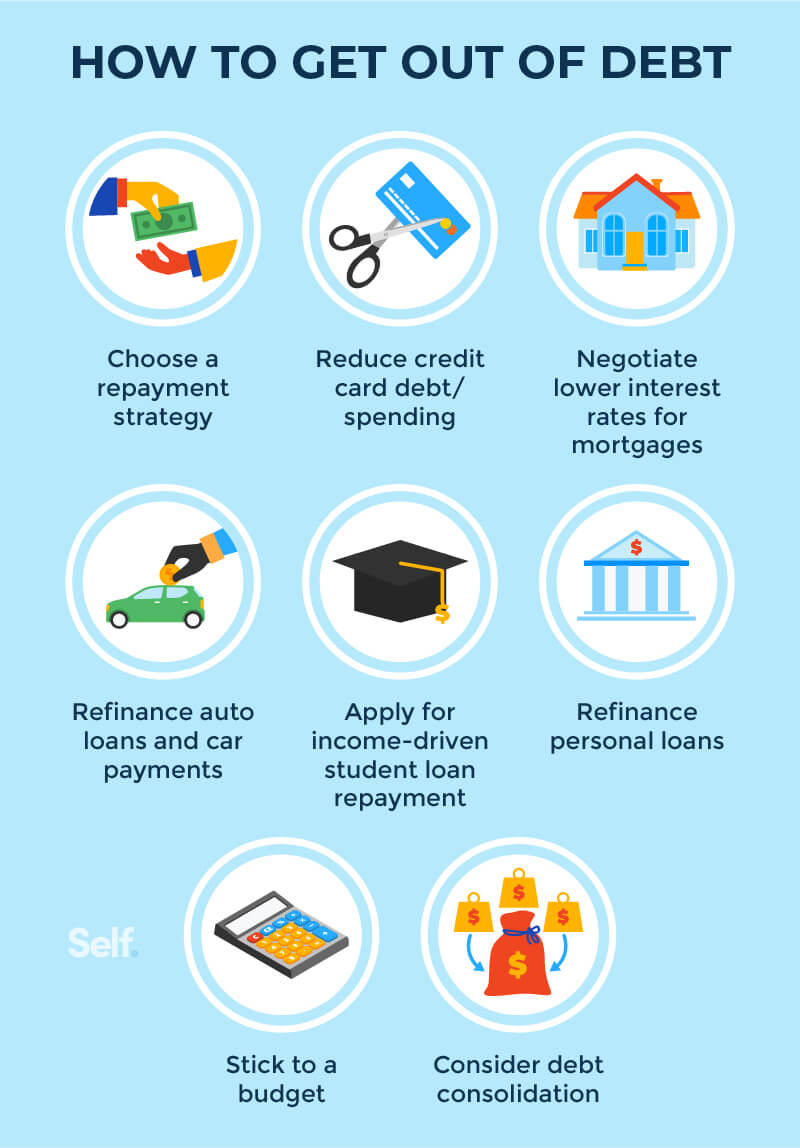
    Loans to Get Out of Debt

    Credit: www.self.inc

    Types Of Loans Available

    When it comes to getting out of debt, choosing the right loan option can make a significant difference in your financial journey. Different types of loans are available for individuals looking to consolidate and manage their debt effectively. Let’s explore two popular loan options – Personal loans and Balance transfer credit cards – in detail:

    Personal Loans

    A personal loan is a flexible financial tool that can help you consolidate and pay off your debts. It is an unsecured loan, meaning you don’t need to provide any collateral. Personal loans are available from banks, credit unions, and online lenders.

    Here are the key features of a personal loan:

    1. Flexible loan amounts ranging from a few hundred dollars to tens of thousands of dollars.
    2. Fixed interest rates and monthly payments, making it easier to budget.
    3. Repayment terms typically range from one to five years.

    Personal loans offer various benefits, such as:

    • Consolidating multiple debts into a single monthly payment, making it easier to manage.
    • Lower interest rates compared to credit cards, especially if you have a good credit score.
    • Fixed repayment schedule, ensuring you stay on track with your debt payments.

    Balance Transfer Credit Cards

    Another option to consider when looking for loans to get out of debt is a balance transfer credit card. This type of credit card allows you to transfer your existing credit card balances to a new card with a lower interest rate, often an introductory 0% APR for a specific period.

    Here’s what you need to know about balance transfer credit cards:

    1. Introductory 0% APR offers can range from 6 to 18 months, giving you time to pay off your debt without accumulating additional interest.
    2. Transferring your balances to a single card simplifies your repayment process.
    3. Ensure you understand the terms and fees associated with balance transfers, including any balance transfer fees or the APR that applies after the introductory period.

    Balance transfer credit cards can be beneficial in the following ways:

    • Save money on interest payments, which can help you pay off your debt more quickly.
    • Consolidate your credit card debt into one manageable payment.
    • Take advantage of introductory offers to pay down your debt faster.

    Before choosing a balance transfer credit card or a personal loan, carefully evaluate your financial situation, consider the terms and conditions, and compare interest rates and fees. This will help you make an informed decision and choose the loan option that best fits your needs.


    Evaluating Loan Options

    Facing a mountain of debt can be overwhelming, but taking out a loan can help you regain control of your finances. However, it’s crucial to evaluate your loan options carefully to make an informed decision. By comparing interest rates and examining repayment terms, you can choose the loan that suits your needs the best.

    Comparing Interest Rates

    One of the key factors to consider when evaluating loan options is the interest rate. The interest rate determines the amount you’ll pay in addition to the principal loan amount. To ensure you’re getting the best deal, comparing interest rates from multiple lenders is essential. Look for lenders that offer competitive rates, as even a small difference in interest rates can significantly impact your overall repayment amount. Consider creating a table to compare interest rates offered by different lenders, enabling you to find the most favorable option.

    Examining Repayment Terms

    Beyond interest rates, it’s crucial to examine the repayment terms offered by each lender. Repayment terms include factors such as the duration of the loan and the monthly payment amount. Longer repayment terms may offer lower monthly payments but could result in paying more interest over time. On the other hand, shorter repayment terms may come with higher monthly payments but can help you pay off your debt faster. By carefully examining these terms, you can find a balance that suits your financial situation. Consider creating a list with specific details of each lender’s repayment terms to help you make an informed choice.

    Remember, evaluating loan options requires a thorough assessment of interest rates and repayment terms. By taking the time to compare and analyze these details, you can find a loan that aligns with your financial goals, ultimately helping you get out of debt more efficiently.

    Loans to Get Out of Debt

    Credit: www.coastal24.com

    Applying For A Loan

    Looking to get out of debt? Applying for a loan could be the solution you need. Find the right loan option to help you consolidate your debts and pave the way towards financial freedom.

    Gathering Necessary Documents

    Before applying for a loan to get out of debt, it’s important to gather all the necessary documents. Take a look at the table below for a quick overview of the documents you’ll need:

    Document Description Importance
    Proof of income Recent pay stubs or tax returns Shows your ability to repay the loan
    Identification Valid government-issued ID Confirms your identity
    Employment details Contact information and duration of employment Verifies stability and income source
    Bank statements Recent statements from your bank account Provides insight into your financial situation
    Credit history Credit reports from all major bureaus Informs lenders about your creditworthiness

    By having these documents ready, you’ll streamline the application process and increase your chances of approval. Remember, bold and organized documentation speaks volumes about your commitment to repayment.

    Completing The Application Process

    Once you have gathered the necessary documents, it’s time to complete the loan application. Follow these steps to ensure a smooth and efficient process:

    1. Find a trusted lender: Research reputable lenders with favorable terms and rates.
    2. Review eligibility criteria: Check the lender’s requirements to make sure you qualify for the loan.
    3. Fill out the application: Provide accurate and complete information to avoid delays or rejections.
    4. Submit required documents: Attach the gathered documents to support your application.
    5. Include additional information: If needed, provide any supplementary details requested by the lender.
    6. Double-check for accuracy: Ensure all the information entered is correct and error-free.
    7. Submit your application: Send the application and documents electronically or through the lender’s preferred method.

    Remember, honesty and accuracy throughout the application process are key to building trust with the lender.

    Loans to Get Out of Debt

    Credit: www.investopedia.com

    Frequently Asked Questions For Loans To Get Out Of Debt

    Can I Get A Loan To Get Out Of Debt?

    Yes, you can get a loan to help you pay off your debts. It can consolidate your debt into one monthly payment, making it easier to manage. However, consider your financial situation and make sure you can afford the loan before applying.

    Can I Get A Loan To Clear My Debts?

    Yes, you can get a loan to clear your debts. Many lenders offer debt consolidation loans to help you pay off multiple debts with a single loan. Make sure to compare interest rates and terms before applying.

    What Type Of Loan Is Best For Paying Off Debt?

    The best loan for paying off debt depends on your situation, but options like personal loans or debt consolidation loans can be ideal. These loans offer lower interest rates, flexible repayment terms, and can help you consolidate your debts into one manageable payment.

    Can I Get A Government Loan To Pay Off Debt?

    Yes, you can get a government loan to pay off debt. These loans are specifically designed to help individuals manage and eliminate their debt burden. Check with your local government or financial institutions for more information on the eligibility criteria and application process.

    Conclusion

    Taking out a loan can be a viable option for getting out of debt. By carefully comparing and selecting the right loan, you can consolidate your debts, reduce interest rates, and simplify your repayment process. However, it is essential to approach loans responsibly and ensure that you have a solid plan in place to repay them.

    Remember to consider your financial situation and consult with a professional before making any final decisions. Take control of your debt and work towards a debt-free future.

  • How To Invest In Commodities?

    To invest in commodities, open a commodities brokerage account and research the market trends. Consider diversifying your portfolio to manage risks effectively.

    Investing in commodities can be an appealing option for investors looking to diversify their portfolio and hedge against inflation. Commodities include raw materials such as gold, oil, agricultural products, and more. While investing in this market can offer opportunities for significant returns, it also carries inherent risks and requires careful consideration.

    Before diving into commodity investment, it’s crucial to understand the market dynamics and have a well-defined investment strategy. Investors can choose from various options such as futures contracts, exchange-traded funds (ETFs), and commodity mutual funds. By carefully assessing the market and staying informed about global economic conditions, investors can make informed decisions to maximize their returns while managing risks effectively.

    The Basics Of Commodities Investing

    When it comes to investing, considering commodities as part of your portfolio can provide diversification and a hedge against inflation. Understanding the basics of commodities investing is essential for making informed investment decisions.

    Diversifying Your Portfolio

    Diversifying your portfolio by including commodities can help reduce overall volatility and risk. By investing in commodities, investors can spread risk across different asset classes, as commodities often have a low correlation with stocks and bonds. This can help mitigate losses in times of economic uncertainty and market downturns. Including commodities in a portfolio can also provide protection against inflation, as the prices of certain commodities tend to rise in inflationary environments.

    Understanding Commodities Market

    Understanding the commodities market is crucial before investing in commodities. Commodities are raw materials or primary agricultural products that can be bought and sold. They can be categorized into four main groups: energy, metals, agriculture, and livestock. Each group has its own unique supply and demand dynamics, influenced by factors such as geopolitical events, weather patterns, and technological advancements.

    Types Of Commodities To Invest In

    If you are considering investing in commodities, it is important to understand the various options available to you. Commodities can be broadly categorized into two main types: Agricultural Commodities and Natural Resources. Each type has its own distinct characteristics and investment opportunities. Let’s take a closer look at each category:

    Agricultural Commodities

    Agricultural commodities refer to products that are cultivated or grown on farms. These commodities are the products of agricultural activities and can include items such as corn, wheat, soybeans, coffee, cocoa, and sugar. Investing in agricultural commodities can be attractive, especially considering the increasing global population and the growing demand for food. Agricultural commodities can provide investors with diversification, as their prices are influenced by factors such as weather conditions, government policies, and global demand.

    When investing in agricultural commodities, it is important to consider the seasonal nature of these products. For example, the price of wheat tends to increase during planting and harvesting seasons, while the demand for coffee and cocoa may be impacted by weather conditions in the countries where they are produced. As an investor, staying informed about these factors can help you make informed decisions.

    Natural Resources

    Natural resources are commodities that are obtained from the earth and have economic value. These resources can include items such as oil, natural gas, precious metals like gold and silver, as well as industrial metals like copper and aluminum. Investing in natural resources can provide opportunities for capital appreciation and act as a hedge against inflation.

    One major advantage of investing in natural resources is their limited supply. As these resources are finite, their value tends to increase over time. Factors that can influence the prices of natural resources include geopolitical tensions, changes in government policies, and technological advancements.

    When investing in natural resources, it is important to consider the global demand and supply dynamics. For example, the price of oil can be influenced by geopolitical events in oil-producing regions, while the demand for precious metals may increase during times of economic uncertainty.

    Investing in commodities can be an effective way to diversify your investment portfolio and potentially benefit from price movements in the global markets. Whether you choose to invest in agricultural commodities or natural resources, it is important to conduct thorough research, stay informed about market trends, and carefully assess the risks involved.


    Ways To Invest In Commodities

    Investing in commodities can be an excellent way to diversify your portfolio and potentially achieve attractive returns. Whether you’re a seasoned investor or just starting, there are several ways you can get involved in the world of commodities. Let’s take a closer look at these options:

    Physical Commodities

    One of the most direct ways to invest in commodities is by acquiring physical assets. This involves purchasing tangible goods like gold, silver, crude oil, or agricultural products. By owning the physical commodity, you directly participate in its supply and demand dynamics, which can lead to potential growth and profitability.

    Here are a few popular physical commodities you might consider investing in:

    • Gold: Known as a safe haven investment, gold has historically retained its value during economic downturns.
    • Silver: Often seen as a more affordable alternative to gold, silver offers potential appreciation and serves as a store of value.
    • Crude Oil: As a vital energy source, crude oil presents opportunities for investors to profit from fluctuations in global demand and supply.
    • Agricultural Products: Investing in commodities like wheat, corn, or soybeans can be appealing due to the growing global population’s demand for food.

    When investing in physical commodities, it’s essential to consider factors such as storage, insurance, and market liquidity. Furthermore, staying informed about market trends and global events that can impact commodity prices is crucial for making informed investment decisions.

    Commodity Futures

    Another way to invest in commodities is through commodity futures. Futures contracts allow investors to speculate on the price movements of various commodities without owning the physical asset.

    Here’s how it works: When you purchase a commodity futures contract, you’re essentially agreeing to buy or sell a specified quantity of the commodity at a predetermined price and future date. This type of investment vehicle offers the potential to profit from both rising and falling commodity prices.

    Commodity futures can be traded on regulated exchanges, providing transparency and standardized terms. Some of the most popular commodity futures contracts include gold, crude oil, natural gas, copper, and corn.

    Investing in commodity futures requires a sound understanding of the market, price dynamics, and risk management strategies. It’s essential to conduct thorough research and possibly consult with a professional advisor before venturing into this investment avenue.

    Whether you choose to invest in physical commodities or explore the possibilities of commodity futures, it’s important to align your investment goals with your risk appetite and consider diversification to mitigate potential risks. By carefully evaluating your options and staying informed, you can navigate the world of commodities and potentially reap the rewards of your investments.

    Factors To Consider Before Investing

    Before diving into commodities investment, it’s crucial to thoroughly consider several factors that can significantly impact your investment strategy. Understanding these key factors will help you make informed decisions and mitigate potential risks. Let’s explore some essential aspects to consider before diving into the world of commodities investing.

    Market Analysis

    Conducting a comprehensive market analysis is paramount when considering commodities investment. Analyzing supply and demand dynamics, geopolitical factors, and macroeconomic trends can provide valuable insights into potential investment opportunities. Moreover, keeping a close eye on emerging markets and global economic indicators can help in capitalizing on market trends.

    Volatility And Risk Management

    Volatility is inherent in commodity markets, making risk management a critical aspect of any investment strategy. Establishing robust risk management protocols and diversifying your portfolio can help in mitigating the impact of price fluctuations. Additionally, setting predefined risk thresholds and employing hedging strategies can protect your investments from adverse market movements.

    Frequently Asked Questions On How To Invest In Commodities

    How Can I Buy Commodity?

    You can buy commodities through various channels like online platforms, commodity exchanges, and physical markets. Start by researching the specific commodity, finding a trusted seller, and making a purchase through a secure method. Always consider factors like quality, price, and authenticity before buying.

    Which Commodity Is Best For Investment?

    Gold is the best commodity for investment due to its stability, high value, and historical track record. It is sought after by investors for its ability to hedge against economic uncertainties and inflation. Its demand remains steady, making it a reliable long-term investment option.

    Are Commodities Worth Investing?

    Commodities can be a worthwhile investment option. They can offer diversification and act as a hedge against inflation. However, it’s vital to consider market dynamics and have a clear investment strategy to profit from commodity investing.

    Conclusion

    Investing in commodities can be a profitable venture if approached strategically. By diversifying your portfolio, staying updated on market trends, and understanding the risks involved, you can make informed decisions to maximize your returns. Remember to conduct thorough research, seek professional advice, and stay patient in the face of volatility.

    With the right approach and a long-term perspective, you can potentially benefit from the unique opportunities that commodities offer.

  • What Is Implicit Bias?

    Implicit bias refers to unconscious attitudes or stereotypes that influence our judgments and behavior without our conscious awareness. Implicit bias refers to the unconscious attitudes or stereotypes that subtly impact our judgments and behavior, operating outside of our conscious awareness.

    These biases can shape our perceptions, decisions, and actions, often without us realizing it. Although people may consciously reject prejudice and discrimination, implicit biases can still remain, influencing how we interact with others. Understanding implicit bias is essential in addressing systemic inequalities and fostering a more inclusive society.

    We will explore the concept of implicit bias, its origins, manifestations, and strategies for mitigating its effects. By increasing our awareness and understanding of implicit bias, we can strive to make more informed and equitable choices in our personal and professional lives.

    Defining Implicit Bias

    Implicit bias refers to the attitudes or stereotypes that affect our understanding, actions, and decisions in an unconscious manner. These biases can have a significant impact on our behavior and interactions with others, often leading to unintentional discrimination. Understanding and addressing implicit bias is crucial for creating a more inclusive and equitable society.

    Implicit bias refers to the attitudes or stereotypes that unconsciously influence our perceptions and actions towards others, even when we are not aware of it. These biases are automatic and often develop as a result of societal and cultural influences.

    Roots Of Implicit Bias

    The origins of implicit bias can be traced back to various factors:

    1. Socialization: Growing up, we are exposed to societal norms and expectations that shape our beliefs and attitudes towards certain groups of people.
    2. Media Influence: The media plays a significant role in shaping our perceptions of different social groups by presenting stereotypes or biases.
    3. Personal Experiences: Our interactions with others, whether positive or negative, can contribute to the formation of implicit biases.
    4. Cultural Differences: People from different cultures may have different implicit biases based on their unique experiences and societal norms.

    It is important to understand that implicit bias does not necessarily reflect one’s explicit beliefs or values. It operates at a subconscious level, often influencing our behavior without our conscious awareness.

    Recognizing and addressing implicit bias requires a willingness to examine our own biases and challenge them. By understanding the root causes and impact of implicit bias, we can actively work towards building more inclusive and equitable communities.

    Effects Of Implicit Bias

    Implicit bias refers to the unconscious attitudes and stereotypes that we hold towards certain groups of people, which can influence our decisions and behaviors without our awareness. These biases are formed based on our socialization and experiences, and they can affect the way we perceive and interact with individuals from different backgrounds.

    Impact On Decision-making

    Implicit bias has a significant impact on decision-making processes. When we make judgments or evaluations, these biases can play a role in influencing our perceptions and choices. Implicit biases can lead us to favor or discriminate against certain individuals without even realizing it.

    Research has shown that implicit bias can affect various areas of decision-making, such as hiring practices, promotions, and even judicial rulings. For example, studies have revealed that people with African-American sounding names are less likely to be called for a job interview compared to individuals with similarly qualified resumes but with names that sound more “white.”

    It is important to note that implicit bias does not equate to intentional discrimination. However, it can result in unequal treatment and perpetuate systemic inequalities in our society. Recognizing and addressing implicit biases is crucial in creating fair and equitable environments.

    Social And Behavioral Implications

    Implicit biases not only affect decision-making but also have broader social and behavioral implications. These biases can influence how we perceive and interact with others, impacting our relationships, attitudes, and actions.

    For instance, implicit biases can affect our ability to empathize and understand the experiences of individuals from different racial, ethnic, or cultural backgrounds. These biases can lead to prejudices and stereotypes, which in turn can contribute to social divisions and discriminatory behaviors.

    Furthermore, implicit bias can influence the way we communicate and form judgments about others. It can impact our nonverbal cues, tone of voice, and overall behavior, potentially creating a hostile or unwelcoming environment for certain individuals or groups.

    Addressing implicit biases requires intentional efforts to promote awareness, education, and inclusivity. By acknowledging and challenging our own biases, we can work towards dismantling discriminatory structures and fostering greater understanding and respect for all individuals.

    Recognizing Implicit Bias

    Implicit bias refers to the unconscious associations and assumptions we hold about certain social groups, without even realizing it. Recognizing implicit bias is an essential step towards addressing and reducing its impact on our thoughts, behaviors, and decisions. By becoming aware of our biases, we can actively work to counteract them and promote more inclusive and equitable environments.

    Self-reflection

    To recognize implicit bias, it is crucial to engage in self-reflection. Take the time to examine your own beliefs, assumptions, and attitudes towards different social groups. Reflecting on your own experiences and upbringing can help you uncover hidden biases that may influence your perceptions. Consider questions like:

    • Do certain stereotypes or prejudices affect your thoughts or actions?
    • Are there any biases you may have inherited from your family or culture?
    • How do your biases shape your interactions with others?

    By honestly answering these questions and critically reflecting on your own biases, you can develop a deeper understanding of your implicit biases and their potential impact.

    Training And Education

    Recognizing and addressing implicit bias can also be supported through training and education. Organizations and institutions can provide workshops, seminars, or diversity training programs that focus on implicit bias awareness. These programs can help individuals develop the knowledge and skills required to recognize and challenge their biases effectively.

    Training sessions can include:

    1. Exploring the concept of implicit bias and how it affects individual and group dynamics
    2. Examining real-life examples and case studies to understand different forms of implicit bias
    3. Learning techniques and strategies to mitigate the influence of biases in decision-making

    By actively promoting training and education aimed at recognizing implicit bias, organizations can foster a more inclusive and tolerant work environment where individuals are empowered to challenge their biases and promote equality.

    Addressing Implicit Bias

    Implicit bias refers to the unconscious attitudes, stereotypes, and prejudices that affect our decisions and actions, often without our awareness. These biases are deeply ingrained within us, shaping our perceptions and judgments about others based on their race, gender, age, or other characteristics. While these biases are not necessarily rooted in hatred or explicit prejudice, they can still have harmful effects, perpetuating inequality and unfair treatment.

    Implementing Bias Awareness Programs

    One effective way to address implicit bias is through the implementation of bias awareness programs. These programs raise awareness about the existence of biases and provide tools and strategies to identify and mitigate their impact. By creating a space for open dialogue and education, organizations can empower individuals to recognize their own biases and work towards overcoming them.

    Policy And Procedural Reforms

    Another important step in addressing implicit bias is implementing policy and procedural reforms. This involves revisiting the existing systems and structures within an organization and identifying areas where biases may influence decision-making processes. By incorporating checks and balances, creating diverse committees, and establishing clear guidelines, organizations can help minimize the impact of bias on important decisions such as hiring, promotions, and resource allocation.

    For example, companies can establish anonymous resume screenings and interview processes that focus on skill assessment rather than personal characteristics. They can also implement diversity quotas to ensure fair representation at all levels of the organization. These reforms send a strong message that bias has no place in decision-making, fostering a more inclusive and equal environment for everyone involved.

    Overcoming Implicit Bias

    Implicit bias refers to the attitudes or stereotypes that affect our understanding, actions, and decisions in an unconscious manner. Overcoming implicit bias is essential in creating fair and equitable environments.

    Strategies For Mitigation

    Self-awareness: Recognizing and acknowledging your own biases is the first step in mitigating them. It allows individuals to consciously consider and potentially change their behavior.

    Learning and Unlearning: Actively educating oneself about different cultures and perspectives, while unlearning stereotypes and assumptions, is crucial in combating bias.

    Stereotype Replacement: Replacing biased thoughts with conscious, unbiased thoughts can weaken the impact of implicit bias over time.

    Creating Inclusive Environments

    Diverse Representation: Striving for diverse representation in leadership and decision-making positions can help counteract bias and improve inclusion.

    Education and Training: Providing comprehensive education and sensitivity training to increase awareness and understanding of implicit bias.

    Policy Implementation: Implementing policies that promote fairness, equity, and inclusivity can help to minimize the effects of implicit bias in organizational settings.

    Frequently Asked Questions For What Is Implicit Bias?

    What Is The Meaning Of Implicit Bias?

    Implicit bias refers to unconscious attitudes and stereotypes that affect our perceptions and actions. It occurs automatically and without conscious awareness. Implicit bias can influence decisions and behavior, leading to discrimination and inequality.

    What Is Implicit Bias Real Examples?

    Implicit bias refers to unconscious attitudes or stereotypes that affect our behavior and decisions. For example, a hiring manager may have a preference for candidates from a certain gender or race without realizing it. Implicit biases can influence actions even when we consciously believe in equality.

    What Are The 3 Types Of Implicit Bias?

    Implicit bias is categorized into three types: explicit biases, automatic biases, and aversive biases.

    Conclusion

    Implicit bias is a subtle force that impacts our beliefs and actions without our conscious awareness. It can shape our perceptions and decisions, leading to unintended consequences. Recognizing and understanding implicit bias is crucial for creating a more inclusive and equal society.

    By taking steps to mitigate its effects, such as increasing awareness, promoting empathy, and encouraging diversity, we can work towards a more just and unbiased world. Let’s unravel the complexities of implicit bias and strive for a society that values fairness and equality.